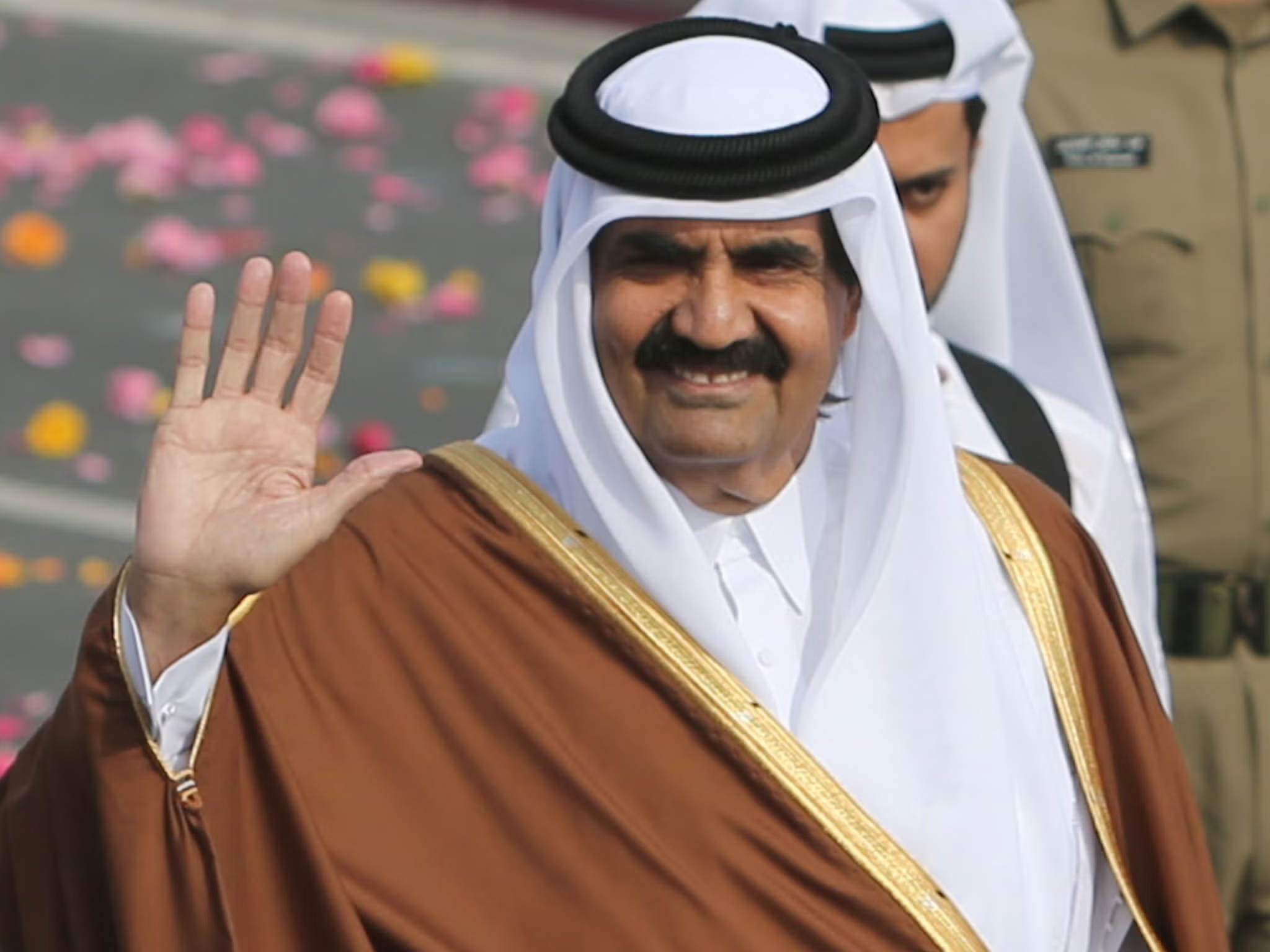
The former Emir of Qatar, Sheikh Hamad bin Khalifa Al Thani, whose 18-year rule from 1995 to 2013 transformed a marginal Gulf Sheikhdom into an influential regional actor in the Middle East, died on July 12 at the age of 74. In a statement announcing his passing, Qatar’s Amiri Diwan called it “the great loss to the nation”. Fondly called “Father Emir” by Qataris, he exerted influence beyond the confines of the Gulf Cooperation Council (GCC), leaving a lasting impact on regional and international affairs. Sheikh Hamad did not simply oversee Qatar’s accumulation of wealth; rather used the energy resources to pursue a coherent and ambitious strategic vision and transform Qatar and its global policy outlook. Understanding his ruling tenure provides a case study of how small states can transform structural weaknesses into sources of strategic leverage.
Origins and Ascent
Born on January 1, 1952, Sheikh Hamad was educated at the Royal Military Academy Sandhurst in the United Kingdom. He was designated heir apparent in 1977 and, over the following years, accumulated responsibility for the day-to-day administration of the state. This period in his life is perceived as the period of decisive confidence. In June 1995, he staged a bloodless palace coup and assumed the emirate’s charge when his father was in Switzerland. The other monarchies of the Gulf regarded the coup as both a personal betrayal of an old friend and a troubling pattern for the prosperity and stability of the hereditary rule throughout the Gulf. At the same time, it is worth noting that the deposed ruler, Sheikh Khalifa, himself came to power in 1972 by overthrowing his own cousin, Ahmed bin Ali Al Thani, a matter of dynastic irony. The succession process within the Al Thani family till that time had hardly followed a peaceful pattern.
Autonomy, Transformation and the Rise of Soft Power
The persuasion of strategic independence is what differentiates Sheikh Hamad from many of his regional counterparts. Before 1995, Qatar aligned its foreign policy with Saudi preferences and relied on the kingdom for security guarantees, thereby functioning under Saudi patronage. The emir of Qatar offered an independent and durable security to Qatar. It was hailed as a transformation from a “Saudi vassal state” into a regional power. Three instruments helped this transformation. The hydrocarbon wealth was the first. The exploitation of the North Field in Qatar, the world’s largest natural gas reservoir, gave Qatar financial independence. The second was the media. Sheikh Hamad founded Al Jazeera, a world-renowned media platform and satellite news network, in 1996, decisively breaking from the revered traditions of Arab state broadcasting. Al Jazeera pursued an editorial line that gave airtime to Saudi dissidents, Islamist movements, and its willingness to criticise the monarchies of the Gulf, which became a formidable tool of Qatar’s soft power. The Al-Jazeera network enabled Qatar to shape regional narratives, project political influence, and enhance its global visibility. Its widespread reporting on conflicts in the region and political debates positioned Qatar as a hub of Arab public discourse, giving the small Gulf state an influence that far exceeded its territorial and demographic size. This capability to shape perceptions and attract audiences worldwide significantly increased Qatar’s diplomatic leverage.
Simultaneously, Al-Jazeera’s editorial independence produced persistent tensions with neighbouring Gulf countries. Its critical coverage of Saudi Arabia and other Arab countries often triggered diplomatic clashes, highlighting how Qatar’s pursuit of influence through Al-Jazeera more often came at the cost of regional consensus. The third instrument was the diversification of the security. After Saudi Arabia refused to host the U.S. forces for the 2003 invasion of Iraq, Washington moved to Doha as an alternative instead, and the resulting military agreement produced the Al Udeid Air Base, the largest of the U.S. military bases in the Middle East. As a result of hosting U.S. forces on a large scale, Qatar acquired a security guarantee that owed nothing to Saudi Arabia’s goodwill.
At various points, Saudi Arabia and other Gulf monarchies, such as the UAE and Bahrain, responded harshly to this emerging independence. It is widely believed that Saudi Arabia, the UAE and Bahrain had supported an attempted counter-coup against Sheikh Hamad in 1996, and possibly a second in the early 2000s. Saudi Arabia also withdrew its ambassador from Doha between 2002 and 2008 in reaction to controversial comments that were made on the Al Jazeera satellite channel by Saudi dissidents critical of the Saudi ruling family. The displeasure of the other Gulf monarchies was intensified by the warming relationship between Qatar and Iran, with which Qatar shares custodianship of the North Field, and by Qatar’s support for the Muslim Brotherhood, which has long been perceived as an existential threat by the monarchies of Saudi Arabia, the UAE, and Bahrain.
Qatar as a Mediator
It would not be accurate to portray Sheikh Hamad’s foreign policy as driven solely by opposition to other regional powers. Qatar, under the rule of Sheikh Hamad, cultivated a reputation as an indispensable intermediary, a state willing to maintain channels with players that other governments would not touch. Qatar positioned itself as a mediator in a wide range of conflicts, from the Israeli-Palestinian dispute to Darfur and Lebanon. It also hosted exiled political actors and dissidents from throughout the Arab world and became one of the largest providers of per-capita foreign development assistance. This willingness to engage with a large number of players simultaneously, like the U.S., Israel, Iran, Hamas, and the Taliban, invited criticism from time to time from Western capitals, yet the same channels which the Qatar maintained were also, several times, found useful by those same governments when direct engagement with a given party was impossible politically.
Domestic Transformation
Sheikh Hamad’s tenure domestically coincided with the massive expansion of Qatar’s LNG industry, which, by the early 2000s, had raised the country among the highest per capita incomes in the world. This wealth funded an ambitious programme of international visibility, most noticeably in sports. Qatar successfully bid to host the 2022 FIFA World Cup in 2010, during the tenure of Sheikh Hamad. It became the signature achievement of his campaign for prestige on the world stage. Qatari capital, at the same time, developed a global footprint through sovereign investment, including ownership of London’s Harrods department store and massive stakes in European football, most notably at Paris Saint-Germain.
Legacy
Sheikh Hamad is regarded as the architect of Qatar’s independent foreign policy. The independent foreign policy which he constructed proved enough durable to survive the most serious test it would face after his abdication, the Saudi-led blockade of Qatar from 2017-2021, in which Saudi, UAE, Bahrain, and Egypt severed the diplomatic and transport links with Qatar, partly in protest at precisely against the policies of Qatar like support for political Islam, relations with Iran, and the platform afforded by Al Jazeera, that Sheikh Hamad had established two decades earlier. That Qatar weathered the blockade without substantially changing these positions, and that relations were again normalised on terms that left Qatar’s core policies largely intact, stands as perhaps the clearest vindication of the strategic architecture he built.
The legacy of Sheikh Hamad is shaped not only by his transformative leadership but also by how he left office. He voluntarily transferred power to his son, Sheikh Tamim bin Hamad Al Thani, in 2013. At a time when Arab Spring uprisings deepened demands for political transformation and generational change, the orderly succession projected an image of institutional stability and continuity. After 2013, Sheikh Hamad withdrew from public life but remained an influential presence within the ruling family. The greatest legacy of Sheikh Hamad is not merely the transformation of Qatar, but the demonstration that a small state, when guided by strategic vision and effective diplomacy, can exert influence far beyond its size. The architecture he built survived every attempt to dismantle it. Qataris today owe much of their security, stability, and prosperity to the risks he was willing to absorb on behalf of the state.
*****