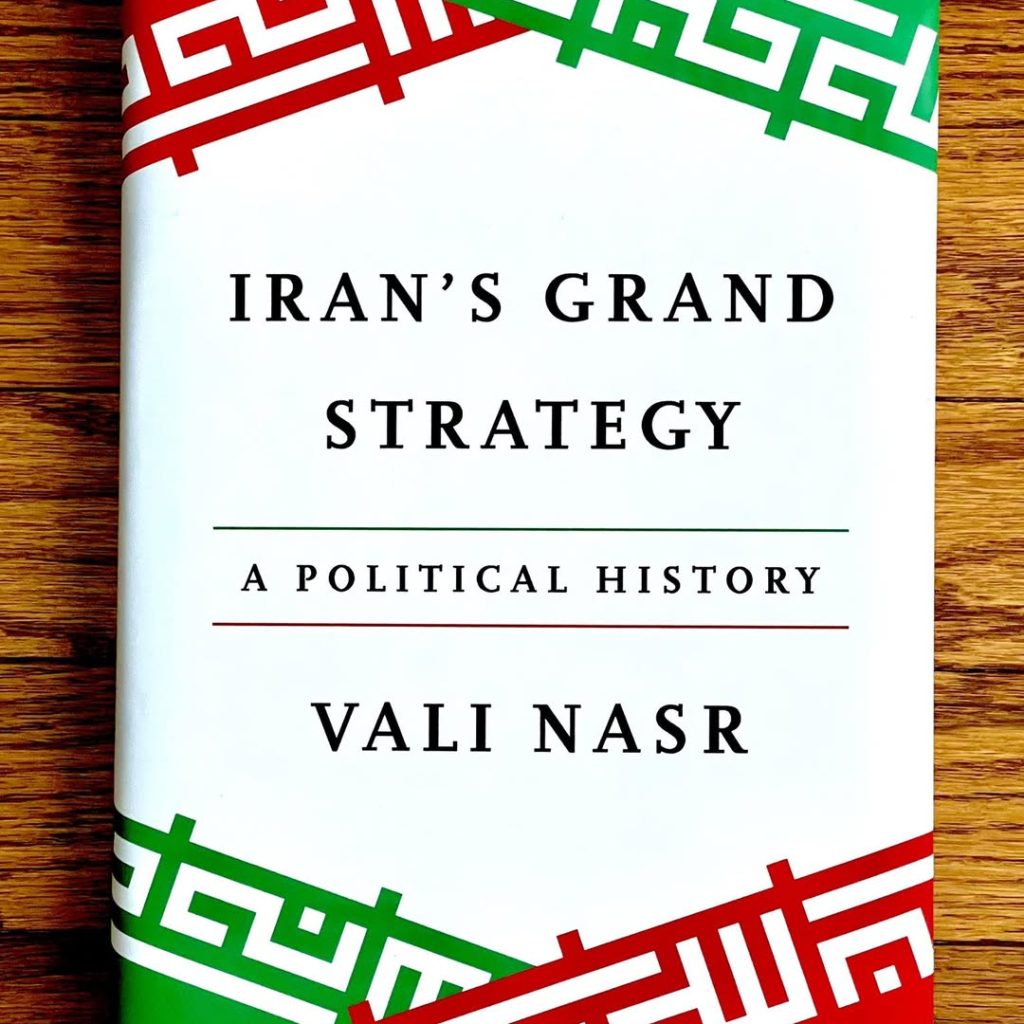
At times when Iran’s resistance is beleaguered, Vali Nasr’s book, “The Grand Strategy of Iran: A Political History”, traces the long-term strategic logic centred on Iran’s security, state survival, independence, and regional influence. The book delves into the evolution of grand strategy and the making of Iran’s internal and external policies in the contemporary realm. It reinterprets the ambiguous outlook of Iran towards the Global powers and the world, rather than seeing it as a product of religious fervour and an ideologically driven state. It emphasises events like the Iran-Iraq war, American Hostage crises, American sanctions and containment, the nuclear gambit, which eventually shaped the strategy and resilience of modern Iran. Starting with the recent October 7 attack by Hamas on Israel, the book revisits the relationship between Iran and the resistance groups of the Axis of Resistance (Hamas, Hezbollah and Houthis). And also ponders over the devastating Israeli military response in Gaza and the outlook of the West towards Iran and the war.
The book begins by tracing the origins of the Islamic Republic to the 1979 Iranian Revolution, driven by revolutionary ideology and deep suspicion of foreign interference. Nasr asserts that the anti-American and anti-Western sentiments of the Shia clerical regime cannot be divorced from the events that preceded the revolution, particularly the 1953 coup against Prime Minister Mohammad Mossadegh, which profoundly shaped the Iranian attitudes towards the United States. The American embassy siege by Iranian students in Tehran, leading to a 444-day hostage crisis, further entrenched anti-Americanism in the political identity of the revolutionary regime as it took shape. But instead of treating anti-Americanism as a purely ideological phenomenon, Nasr presents it as an operational strategic doctrine used by successive Iranian leaders to gauge American intentions and guide policies aimed at protecting the revolution and preserving the Islamic Republic.
The second part of the book focuses on the Iran-Iraq war and Iranian attempts at rebuilding a war-torn state. Besides devastating the Iranian economy, it very much altered Tehran’s strategic doctrine and reshaped the Islamic Republic as a whole by revealing its conventional weaknesses, which ought to be compensated by ideological mobilisation, reliance on asymmetric tactics and self-sufficiency in technology. It forged the idea of ‘Sacred Defense,’ and influenced Tehran’s worldview in which compromise on national security and ideology was deemed unacceptable. Beyond rebuilding a war-ravaged economy, the Iranian leadership also faced the challenge of preserving the revolution’s ideological foundations while ensuring political stability. This resulted in comprehensive constitutional changes shortly before Ayatollah Khomeini’s death in 1989 that shaped the state’s institutional structure, particularly expanding velayat-e motlaqeh-ye faqih, or the ‘absolute guardianship of the Jurist’, which formally centralised sweeping executive and legislative veto powers under the Supreme Leader. These changes shaped the state’s institutional structure by strengthened supreme leader’s authority. It is this powerful authority which was inherited by Ayatollah Ali Khamenei in 1989 when he succeeded Khomeini. Nasr asserts that while the revolution gave rise to the Islamic Republic, the hostage crisis defined its anti-Americanism, and the war helped make the state and shape its regional and international orientation.
One of the compelling insights of Nasr’s work is the analysis of the linkage between Iran’s domestic politics and foreign policy. The author posits that successive Iranian presidents undertook several diplomatic initiatives to normalise relations with the U.S., yet these were all stymied by mutual suspicion, domestic political considerations, and changing American postures. Nasr argues that this repeated diplomatic failure only reinforced the Iranian conviction that U.S. policy towards Tehran was driven by regime change rather than reconciliation, deepening the Islamic Republic’s commitment to pursuing and preserving its strategic autonomy. As part of these pursuits, the book traces the crucial rise of the Islamic Revolutionary Guard Corps (IRGC), explaining its transition from a revolutionary military force into an influential political and economic actor directly tied to the office of the supreme leader, unlike the regular national army. Its importance in creating networks, including economic networks capable of circumventing international sanctions, and in implementing Tehran’s regional strategy made the IRGC indispensable to the state’s project of authoritarian resilience. In doing so, Nasr seamlessly ties foreign policy to more than just security, connecting it to power dynamics, economic interests, and the changing composition of Iran’s political elite.
Within this approach, the author emphasises the doctrine of “forward defence,” which he suggests uniquely characterises the Islamic Republic’s grand strategy. Rather than waiting for conflict to reach Iranian territory, Tehran has sought to push the theatre of confrontation into the broader Middle East, where it can build deterrence through allied actors such as Hezbollah, Hamas, and the Houthis, thereby gaining strategic depth. The role of the Iranian state during the Syrian civil war and the distorted view it fostered of the state are discussed in this context. The same goes for the Iranian nuclear programme, which he describes as a strategic tool aimed at enhancing deterrence and leverage given continued sanctions and negotiations with international powers. The same goes for the Iranian nuclear programme, which he describes as a strategic tool aimed at enhancing deterrence and leverage given continued sanctions and negotiations with international powers. Tracing the internal debates surrounding the Joint Comprehensive Plan of Action (JCPOA), Nasr highlights how the US withdrawal from the deal confirmed and deepened Tehran’s cynicism toward diplomatic solutions, contributing to the formation of a domestic economy and political culture geared toward resistance and self-sufficiency.
This book is more than a mere chronological account of the Islamic Republic’s political history, providing a powerful interpretation of the strategic rationale underpinning Iran’s behaviour. It contends that Tehran’s behaviour is best understood through the lens of historical insecurity, institutional evolution, and the pursuit of state survival rather than through simplistic assumptions about religious extremism or ideological irrationality. By tracing the long process of revolution, war, sanctions, and isolation that have shaped Iran since 1979, Nasr portrays the country as a rational strategic actor (not necessarily benign, though). Even if the reader does not fully subscribe to Nasr’s interpretation, he is surely driven to consider conventional understandings of the Iranian statecraft.
The book is most persuasive when explaining the strategic foundations of the Islamic Republic; however, its emphasis on strategic rationality occasionally comes at the expense of a fuller engagement with the regime’s coercive and authoritarian dimensions. While the author acknowledges the ideological gap between younger Iranians and the revolutionary generation, he provides relatively little coverage of growing domestic dissent, particularly in recent years. In addition, there is limited engagements with the detrimental economic consequences of prolonged sanctions, the impact of economic stagnation on ordinary citizens, or the widespread protests that have exposed deep fractures within Iranian society. Likewise, while state repression is acknowledged, it is not examined with the same analytical depth as questions of strategy, deterrence, and regional influence. As a result, the voices of ordinary Iranians whose everyday experiences increasingly shape the legitimacy and sustainability of the Islamic Republic remain largely absent from the narrative. A more sustained engagement with these domestic dynamics would have produced a more balanced assessment of the strengths and limitations of Iran’s grand strategy.
Overall, Iran’s Grand Strategy is a significant contribution to the study of Iranian politics and Middle Eastern international relations. Nasr challenges reductionist portrayals of Iran by demonstrating that the Islamic Republic’s strategic behaviour has been shaped by decades of perceived insecurity, geopolitical isolation, and institutional adaptation. With the profound changes underway in the region, including the American-Israeli war against Iran, this book assumes more significance by providing an essential framework for understanding both the evolution and the future trajectory of Iran’s grand strategy.