The war that has convulsed West Asia since February has tested every regional relationship, but few as quietly and as consequentially as the one between India and Iran. Neither country asked for this conflict. Both are now absorbing its costs. As missiles gave way to a fragile ceasefire in recent weeks, New Delhi and Tehran have had to manage a partnership that is older than either republic and increasingly tested by the arithmetic of sanctions and supply chain closure.
The most visible strain has been Chabahar port, which was recently attacked in a US strike. India’s ten-year contract to run the Shahid Beheshti terminal, signed in May 2024 with a commitment of USD 120 million in equipment and an additional USD 250 million credit line, was meant to anchor India’s access to Afghanistan, Central Asia, and, through the International North-South Transport Corridor, to Russia and Europe. When the American sanctions waiver for the port lapsed on April 26, India found itself walking a tightrope, transferring funds to keep the terminal running while reportedly exploring a temporary handover of its stake to an Iranian entity, with an option to return. External Affairs Minister S. Jaishankar told Parliament that India “remains engaged with all concerned in order to address the implications of these developments”.
India’s energy ties with Iran ran deeper before sanctions. Between 2007 and 2019, Iran consistently ranked within India’s top 10 crude suppliers, before falling to near zero under renewed US sanctions. The bond also runs through faith: India has an estimated 30 to 40 million Shia Muslims, the world’s second-largest Shia population after Iran, with generations of Indian students trained at Qom and Mashhad, while many Indians in Iran are pursuing MBBS and medical degrees.
A Partnership Bigger Than One Port
It would be a mistake to let Chabahar’s uncertainty define the whole relationship. India and Iran are bound by ties that predate the modern nation-state. Persian was the language of the Mughal court and of Indian administration for centuries. Zoroastrian Parsis found permanent refuge on India’s western coast. Sufi and mystic traditions moved freely between Shiraz, Isfahan and Delhi long before either country had a foreign ministry.
Iran remains home to a Shia population attentive to Indian affairs, and India remains home to the world’s second-largest Shia population outside Iran. This has allowed two governments with different alignments to keep talking, even when it is inconvenient. That continuity has practical value now. Michael Kugelman has warned that a full Indian withdrawal from Chabahar would leave a vacuum that China is well placed to fill, given Beijing’s twenty-five-year cooperation agreement with Tehran and its comparative indifference to American sanctions pressure. Chatham House’s Chietigj Bajpaee has separately noted that continued disruption on the Iran route could push India toward the India Middle East Europe Corridor (IMEC) as an alternative, but even he stops short of predicting an Indian exit from the INSTC altogether. The roughly 7,200-kilometre INSTC network linking Indian ports through Iran to the Caspian and onward to Russia and northern Europe took two decades to build. It deserves to be preserved through the current turbulence.
Strategic Autonomy in Practise
India’s response to this war has been instructive precisely because it has been unglamorous. New Delhi has neither condemned Iran nor distanced itself from a relationship it values on its own terms. This is what strategic autonomy looks like in practice: India engages multiple partners across West Asia while keeping its ties with Iran rooted in geography, history and shared strategic interest, not contingent on how any other relationship evolves.
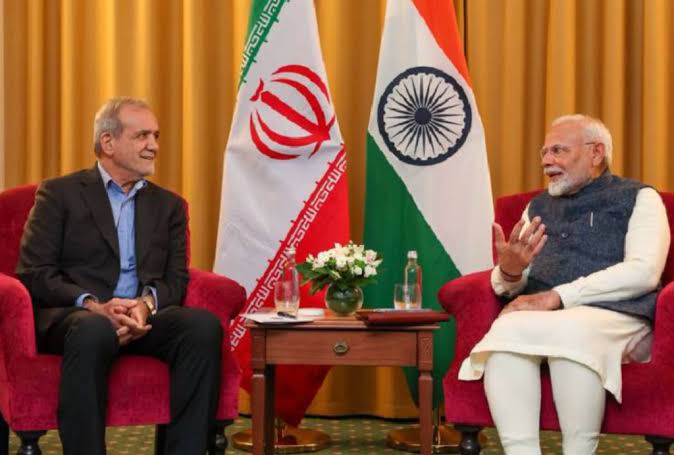
The past two months alone show that willingness on both sides. At the Foreign Ministers’ Meeting on the sidelines of BRICS in May, Prime Minister Modi and External Affairs Minister Jaishankar met Iranian Foreign Minister Abbas Araghchi, with Tehran encouraging New Delhi to use the BRICS platform to advance diplomacy and secure energy markets. In June, National Security Advisor Ajit Doval held talks with Iran’s Deputy Secretary for Defence Affairs, Ghadir Nezamipour, on regional stability and bilateral cooperation. That same month, Iran’s Oil Minister Mohsen Paknejad met Union Minister Hardeep Singh Puri to discuss hydrocarbon ties and the future of Chabahar. Taken together, these engagements show both capitals still see value in staying at the table despite regional volatility.
What’s Next?
War tends to compress diplomacy into transactions. But India and Iran have a longer memory than that, one rooted in shared faith and energy history as much as in ports and corridors. The task now is not to wait out the crisis passively, but to actively reinvest, through renewed contractual clarity on Chabahar, sustained people-to-people exchange, and quiet consistency in political messaging, in a partnership that has outlasted far worse storms than this one.