For most of 2025, Western capitals perceived that Russia’s position in the Middle East was in terminal decline. The fall of Bashar al-Assad in December 2024 undermined Moscow’s policy in the Levant. Furthermore, under Israel’s offensive war against the Kremlin, which the grinding war in Ukraine had already absorbed, it seemed to have neither the bandwidth nor the capital to sustain its influence in the Middle East and, above all, to lose leverage in safeguarding its strategic interests once Washington and Tel Aviv turned their full attention on Tehran. These setbacks fed a narrative that Moscow’s decades-long project of relevance in the Middle East is running out.
A year and a half later, that obituary looks premature. Through a combination of patience, calculated risk-taking, and unapologetic opportunism, Russia has rebuilt working relationships with Tehran, Damascus and Beirut simultaneously- not as a resurgent hegemon capable of dictating outcomes but as an indispensable presence that every actor in the region has concluded it cannot ignore. It has done this less by projecting new power than by redeploying old assets: wheat and fuel shipments, base leases re-negotiated with a government it once considered an enemy, humanitarian flights into an active war zone and a senior envoy dispatched to the funeral of a slain ally. The result is a Russian footprint across Iran and the Levant that is smaller and more improvised than at any point in the past decade, yet in some ways more durable- built less on ideological lines than on the simple fact that Moscow, unlike Washington or Gulf capitals, keeps a line of communication open to everyone.
Russia-Iran Comprehensive Strategic Partnership
The evolving relationship between Moscow and Tehran entered a new legal and strategic dimension with the signing of the Treaty on Comprehensive Strategic Partnership. Deliberately designed to govern bilateral relations for the next twenty years, the treaty covers a broad spectrum of cooperation, including defence, counter-terrorism, energy, technology, and cybersecurity. The timeline of the treaty’s ratification reveals the high level of political priority assigned to the agreement as they navigated severe domestic and regional crises. The 47-article treaty outlines a comprehensive framework to mitigate the impact of Western sanctions, coordinate regional security and combat money laundering and organised crime.
However, the agreement is best characterised as “strategic transactionalism”- a partnership of convenience driven by systemic Western pressure rather than a formal, integrated military alliance. This distinction is highlighted by comparison with the 23-article treaty signed between North Korea and Russia in 2024, which contains an explicit mutual defence clause. Crucially, the Russian-Iranian treaty lacks a mutual defence provision, reflecting Moscow’s reluctance to become legally entangled in Iran’s direct, high-intensity confrontations with Israel and the USA. This strategic restraint was tested during the June 2025 “Twelve-day war”, when Israel and the USA launched direct military strikes targeting Iran’s nuclear and missile programs. While the Kremlin issued sharp rhetorical condemnations, labelling the strikes as unprovoked acts of armed aggression, it did not provide direct military assistance to Tehran.
While Russia has reduced its immediate military reliance on Iran by manufacturing Iranian-designed drones domestically, the two countries are rapidly deepening their economic and geopolitical ties. This expanding partnership is highlighted by growing bilateral trade, billions of dollars in Russian financial support, and the integration of their banking systems to bypass Western financial networks such as SWIFT.
The Geoeconomics Linkages and Sanctions Circumvention
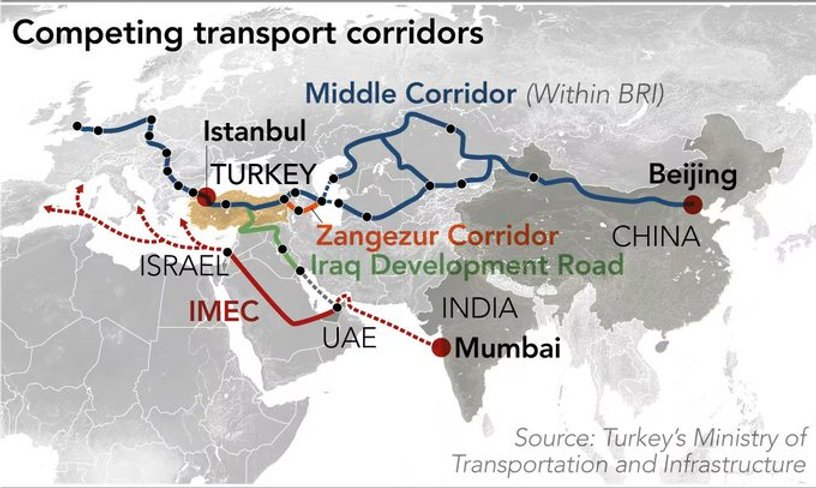
The two countries have spent decades building the International North-South Transport Corridor (INSTC), a 7200-kilometre road, rail, and shipping network meant to connect St. Petersburg to the Indian Ocean via the Caspian Sea and Iran. The INSTC serves as a vital geo-economic alternative to the Suez Canal route, capitalising on significant structural inefficiencies. To manage this complex project, Moscow appointed Vitaly Savelyev in 2024 as the Kremlin’s special representative for INSTC development, coordinating infrastructure roadmaps with transit states to scale the logistics route’s capacity to 15 million tons by 2027.
Iran, given its limited resources, cannot finish the INSTC alone, and the corridor is mainly being built on Russian state loans. For Russia, a functioning corridor enables it to trade with South Asia without passing through the Suez Canal, Turkish territory, or Egyptian ports that western sanctions could shut at will. Russian and Iranian crude increasingly move on an overlapping “shadow fleet” of ageing, opaque tankers that switch flags, fake insurance papers, and go dark on tracking systems mid-voyage. The networks are genuinely shared rather than simply parallel: one tanker seized by American forces in 2024 for moving money to Hezbollah, then resurfaced flying a Russian flag while carrying Venezuelan oil- a small illustration of how thoroughly Moscow, Tehran and Levant militant economies now lean on a single sanctions-busting network.
Post-Assad Rapprochement: Ideological Axis to Pragmatic Survival
While trade corridors and shadow fleets form the economic spine of the Russia-Iran partnership, the Levant remains its real-world testing ground. The fall of Bashar al-Assad upended decades of established regional strategy. For years, Syria served as the central geographical link for Iran’s “Axis of Resistance,” providing an uninterrupted land corridor running from Tehran to Hezbollah in Lebanon. The fall of Assad effectively deprived Iran of its strategic depth. Moscow, on the other hand, reacted with swift pragmatism. Instead of simply cutting its losses, Russia went for power projection in the Mediterranean through its coastal military bases. The Kremlin quickly opened working channels with the new transitional government in Damascus, led by President Ahmad al-Sharaa. Setting aside its former loyalty to the Assad family, Russia reframed its presence in terms of basic state utility rather than ideological alignment. For the new administration in Damascus, maintaining ties with Moscow offers several practical lifelines. On the economic front, a struggling Syrian economy still depends on Russian shipments of wheat and discounted fuel to keep basic domestic markets functioning.
Syria’s armed forces rely heavily on Soviet-era and Russian equipment, making Russian technical expertise essential for keeping basic defence systems operational. Moreover, alignment with Moscow gives Damascus a permanent UN Security Council veto-holder to counter pressure from Western countries and Arab Gulf states. In return, Russia held on to its most strategic regional assets, the Hmeimim Air Base and the Tartus naval port, and repositioned itself as not an occupying patron but a needed partner for regional stability.
Diplomatic Balancing: Israel-Iran Friction
Security between Lebanon and Israel has entered a new and delicate phase as the Syrian resupply route has all but been cut off. Moscow is here a major external balancer with established ties with Tel Aviv, Beirut and Tehran, while Western diplomatic channels are largely inoperative. Hezbollah’s military setbacks, combined with the loss of its Syrian transit routes, have altered Lebanese domestic politics. While Iran tries to salvage what remains of Hezbollah’s influence, Russia has widened its approach, building direct ties across the broader Lebanese political spectrum. Moscow frames this engagement around state sovereignty and institutional stability, offering a neutral alternative to keep the country from sliding into total governance failure. Despite ongoing diplomatic friction between Russia and Israel over Ukraine and Moscow’s closer economic ties with Tehran, both sides maintain a functional de-confliction mechanism in the Levant. For targeted operations, Israeli military strikes in Syria systematically target Iranian-backed logistics while deliberately avoiding core Russian coastal facilities.
Regarding border management, to prevent dangerous escalations, Russia has used its military presence, including border patrols, to act as a buffer against proxy re-entrenchment along sensitive frontier zones. By keeping its military assets out of the direct line of fire, Russia retains a unique diplomatic standing: a necessary contact for Israel on border security, a diplomatic buffer for Iran, and a pragmatic neighbour for Syria’s new leadership.
Conclusion
Russia’s strategy in the Levant balances its global anti-Western ambitions with military constraints caused by the war in Ukraine. Unable to act as a primary security guarantor, Moscow relies on strategic hedging, maintaining influence and significant concessions on sharing nuclear and space technology with Iran. However, it pragmatically avoids direct regional conflicts, maintaining ties with Israel and Gulf states to bypass the sanctions. Ultimately, Russia’s approach remains highly resilient and transactional. By repurposing Syrian bases for logistics and acting as a diplomatic mediator, Moscow continues to protect its interests and challenge Western dominance in the Middle East.