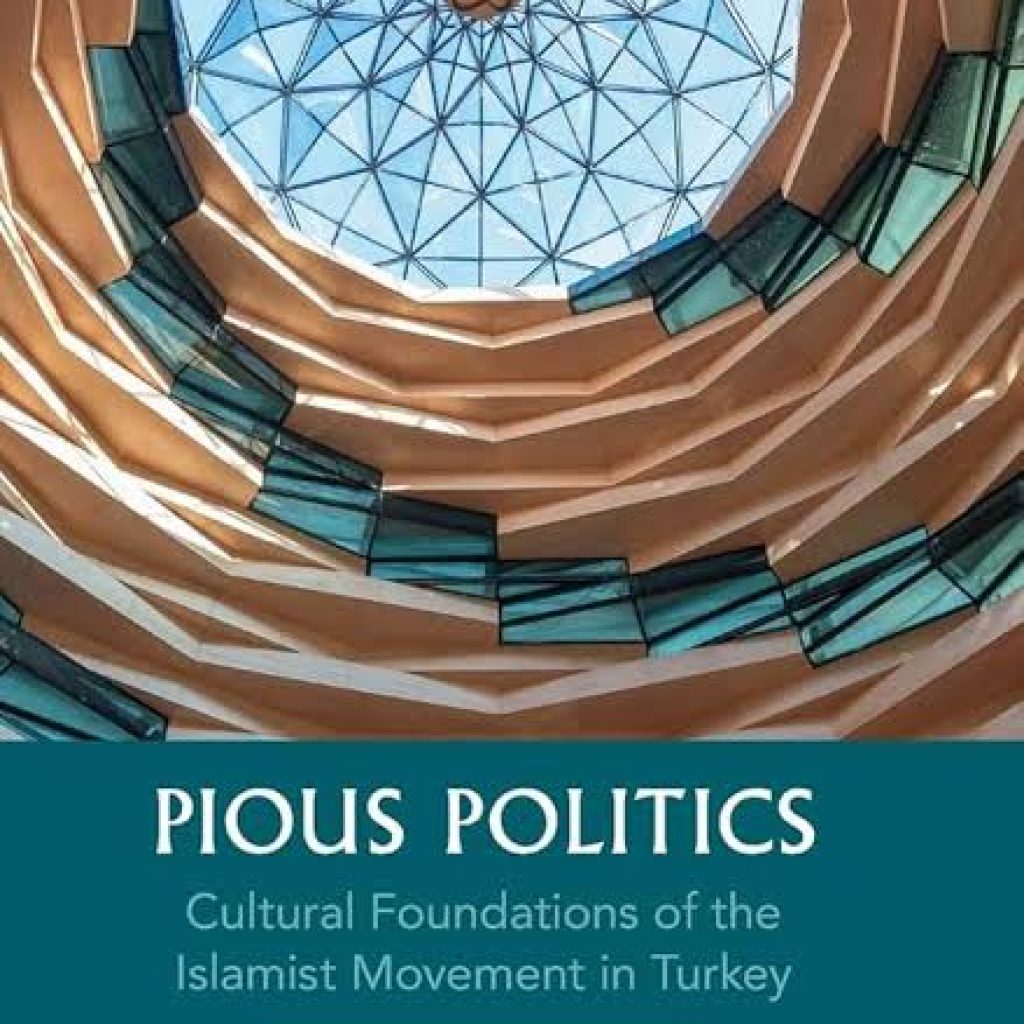
The book “Pious Politics” by Zeynep Özgen discusses the rise of the Islamist movement through a popular and well-organised development in Turkey over decades that rallied the masses, built vigorous political parties, and pressed for legislative reform. But an equally formative – if not more significant – cultural factor was the groundwork Islamists laid through a remarkably robust model of mobilisation. This book examines the formation of the Islamist movement in Turkey from the 1930s to the present, showing its dynamic adaptation to state ambivalence through historical and ethnographic analysis. Özgen argues that Islamists’ seizure of state power depended on the cultural groundwork they laid and the ensuing socio-cultural transformations they effected throughout the twentieth century. Özgen defines the cultural groundwork as sustained efforts to create an alternative world that conditions individuals’ socialisation and shapes the terms through which they conceive it.
The second chapter presents a scholarly sketches out the analytical framework. Özgen devised an explanation of the role of culture in the development of oppositional identities and political mobilisation. This framework draws insights from the work of political, historical, and cultural sociologists and anthropologists. The framework engages with macro approaches which traditionally treated economic and political discontent as the main concern of contentious movements. The third chapter examines the creation of a secular meaning system during the early republic and the emergence of a rudimentary type of dual model of mobilisation in response. In addition, this chapter situates the Islamist movement’s trajectory within the broader space of possibilities and demonstrates the wide-ranging influence of transnational currents and the domestic political environment on the dual model of mobilisation. It shows that all transnational currents advocated for the Islamic state, whose foundations would rest on sharia, but they differed in terms of how to accomplish this goal. The chapter shows that Islamist resistance emerged from a set of contingent goals aimed at surviving unfavourable institutional conditions, which nonetheless evolved into new goals that fuelled religious revivalism.
Following the idea of analysing a social process “in which ‘ends’ and ‘means are constantly shifting in relation to one another,” one can argue that Turkish revivalism is an aggregate product of earlier religious “ends” (e.g., reeducating the youth, reinforcing mass adherence to Islam, or continuing Sunni groups’ activity) that became the “means” for different Islamist groups to accomplish new “ends” (e.g., accumulating capital or gaining political power). The fourth chapter suggests that the Islamist movement in Turkey mirrored competing global visions over the interpretation of religious messages and organisational models. But the concrete form it took was a response to the kind of state to which it was oriented, a state that was ambivalent toward religious activism and thus inclined to toggle between tolerating and repressing the Islamist movement.
The movement’s concrete strategic form was the dual model of mobilisation, whereas its ideological expression was a hybrid vision blending evolutionary and revolutionary schools of thought. This chapter illustrates the appropriation of evolutionary and revolutionary methods by Turkish religious actors. Rather than the macro approach that he used to explain historical events and utopic visions in the previous chapter. Here, Özgen develops a more grounded analysis, drawing on the biographies of individuals situated at opposite ends of the Islamic spectrum and explicating the attendant evolution within the Turkish Islamist movement. He centres this narrative on the main forms of competition and cooperation between groups of Islamists.
The fifth chapter presents the actual workings of the dual model of mobilisation at the everyday level. Having discussed Islamists’ embedding in the formal establishment (the first dimension of the dual model), these chapters disaggregate the vast network of aboveground, in-between, and underground organisations that Islamists created or burrowed into (the second dimension). Each chapter portrays the expansion and contraction of these sites in relation to the political context, as well as the different goals Islamists pursued within them. The chapter examines the role and influence of Imam-Hatip schools, tracing Islamists’ persistent efforts to change the nature and purpose of schools to accomplish a variety of goals, ranging from resuscitating religious sciences and training religiously versed generations to recruiting activists.
The sixth chapter reveals that the movement sustained this shifting relationship through cultural groundwork, developing a network of educational sites parallel to the state’s formal education system. While some focused on moral training, others provided intellectual training in secular subjects. Moreover, the chapter demonstrates that these alternative education sites facilitate the transition of dispositionally reformed individuals into public institutions. Chapter seven revisits the broad empirical and theoretical questions. Özgen highlights the findings and implications of this study in the Turkish case as well as for global movements. Across the Middle East and the globe, religious politics continue to exert significant influence on efforts to change or preserve existing modalities of state–society relations. Finally, Özgen reflect on the lessons that can be drawn from Turkey’s religious politics to improve our understanding of contentious politics more broadly.
In Pious Politics, Özgen successfully decenters traditional, grievance-based models of mobilisation, proving that the capture of state power is often preceded by decades of quiet, cultural groundwork. By demonstrating how alternative educational sites served as a parallel credentialing system, the book offers a compelling blueprint for how oppositional identities negotiate and ultimately transform ambivalent state structures. Beyond its immediate value to scholars of Turkish politics, this work provides a vital theoretical framework for researchers analysing contentious movements, state-society relations, and the structural drivers of political transformation globally.