
What began as a rapid military campaign by the United States and Israel has developed into a prolonged conflict, intensifying instability across the Middle East and placing additional pressure on the global economy. Iran’s ability to sustain its war effort raises queries about the resilience of its domestic defence industry and the external networks that help it withstand military pressure.
China and Russia have turned into key components of this support mechanism for Iran. This arrangement does not rest on any agreement or mutual defence; instead, there are only military-technical, energy, and procurement contacts between the two countries, as well as diplomatic relations. The special feature of this collaboration is that each of these countries possesses specific competences. In this case, Russia has experience in fighting and technological development gained from the war in Ukraine, while China can provide an important market for Iranian oil and the possibility of using commercial supply lines, including those for dual-use technologies. The Caspian Sea also serves as an important transport corridor for trade between Iran and Russia, including the movement of military equipment and other strategic goods.
The conflict in the Persian Gulf has brought these relationships into sharper focus. Russia benefits from Iranian drone technology, China retains access to discounted Iranian oil, and Tehran gains economic and diplomatic support from two major powers that oppose aspects of the US-led international order. These interests provide the basis for what can be described as a shadow axis: a decentralised network of cooperation that strengthens the three countries’ ability to withstand Western pressure across the Middle East and Eurasia. The durability of this arrangement depends on the interaction between military requirements, commercial interests and strategic calculations. Its importance lies in the networks connecting the three countries rather than in the existence of a unified alliance.
The Military-Technical Axis
The Russia-Ukraine conflict of 2022 hastened the military cooperation between Moscow and Tehran, as the Russian forces required cheap long-range attack drones while Iran had drones that could conduct attrition warfare. According to a report by the Centre for Strategic and International Studies (CSIS), the first consignment of Iranian Shahed-136 and Shahed-131 drones arrived in Russia in mid-August 2022. Towards the end of 2022, a Russian delegation visited Iran to conclude a $1.75 billion deal to manufacture the drone at the Alabuga Special Economic Zone in Tatarstan. The drone progressed from an imported drone to one whose design Russian engineers continually refine.
The drones were subsequently designated Geran by Russia and were integrated into a broader adaptation process. This process illustrates how military technology can evolve through sustained use in combat. The Russian engineers adapted the drone design to meet their operational requirements, while battlefield experience helped them understand issues with navigation, electronic warfare, and target engagement.
The relationship has also developed through efforts to overcome electronic interference. Ukrainian forces have used electronic warfare systems to disrupt satellite navigation, prompting Russian engineers to improve the navigation and control systems fitted to Geran drones. These modifications have included controlled-reception-pattern antennas designed to improve resistance to jamming. Reports in 2026 also identified the introduction of jet-powered Geran-4 and Geran-5 variants using Chinese Telefly turbojet engines.
Russia’s support to Iran is alleged to go beyond just missile development and includes other military equipment. In October 2025, Iran International reported a potential deal worth approximately €6 billion for 48 Su-35 combat aircraft to be delivered in 2026-2028; however, the authenticity of the documents could not be verified. According to a report from the Financial Times of 1 September 2026, “Russian engineers have helped Iran develop ramjet engines for hypersonic and supersonic cruise missiles as part of a programme dubbed ‘C430L’.” The extent of Iran’s progress remains uncertain, though.
The broader relationship has an institutional foundation. In January 2025, Iran and Russia agreed to a strategic partnership treaty that envisages cooperation in intelligence exchange, joint exercises, and defence-industrial projects, among other things. These developments point to a relationship in which operational experience, technology transfer and institutional cooperation reinforce one another.
Economic Lifelines
China’s importance to Iran rests heavily on energy trade. China now buys most of Iran’s exported oil. The US–China Economic and Security Review Commission (USCC) estimates Beijing’s share at over 90 per cent of crude exports worth $46.7 billion in 2024. Estimates of the volume of Iranian oil reaching China, however, vary depending on the data sources and methodologies used. Kpler’s tracking of seaborne cargoes, reported by the House Select Committee on China, implies about 852,000 barrels per day from Iran to China in 2025, while United Against Nuclear Iran estimated 1.6 million barrels per day for July 2025, as cited by the USCC. The figures cover different periods and methods, but both show dependence.
Chinese customs data record no oil purchases from Iran. They show rising imports from Malaysia, Oman and the UAE instead. The main buyers are Shandong’s “teapot” refineries, independent refiners that gained the right to import crude in 2015 and have optimised for the heavy, high-sulphur grades that sanctioned suppliers sell. Price discounts further strengthen this relationship. Data cited by the House committee indicate that Iranian crude sold at approximately $0.50–$1 per barrel below Brent crude in early March 2025, with the discount widening to around $8–$10 per barrel by December. The wider discount reflected the commercial and legal risks associated with sanctions and the limited pool of buyers willing to handle these cargoes.
Russia complicates this picture. It supplied 2.2 million barrels per day to China in 2024, accounting for 21.5 per cent of China’s crude imports, using Iran’s shadow-fleet methods. Competing for limited market share, Moscow is as much Tehran’s rival for Chinese demand as its partner.
Oil revenues represent only one part of Iran’s external economic lifeline. Rebuilding and maintaining its defence industry requires machine tools, electronic components, engines and other industrial inputs. The Atlantic Council reported that Western-made electronics, engines, and navigation components continued reaching Iranian buyers via Chinese distributors and trading companies. Components such as inertial sensors and satellite navigation modules pose particular enforcement challenges because they have legitimate civilian applications.
China’s role consequently extends beyond purchasing Iranian oil. Its commercial ecosystem offers potential access to industrial equipment and technologies that Iran needs to maintain its military production. The extent of this support varies by component, supplier and transaction, but the networks create additional channels through which sanctioned entities can seek essential inputs.
Sanctions-Proofing Through Shipping, Payments and Routes
The lifeline survives because each point where sanctions are meant to bite has been engineered around. The first is shipping. Iran’s shadow fleet consists of tankers with opaque ownership, false flags and disabled tracking signals. The USCC cites an estimate that it grew from about 70 vessels in 2020 to nearly 550 by 2025, although many of those ships also began carrying Russian oil. Cargoes loaded at Kharg Island are transferred between ships in the Gulf of Oman and reappear with new paperwork as “Oman Blend” or “Malaysian Light”. US forces seized nine shadow-fleet tankers between December 2025 and February 2026. According to the House committee, those nine ships had delivered about 69.3 million barrels of sanctioned crude to China between 2013 and 2025, of which about 20.3 million barrels were Iranian.
Payment arrangements constitute a second layer. Chinese buyers typically use renminbi transactions within about 45 days and smaller provincial banks with limited exposure to the US dollar financial system. Some transactions also operate through arrangements in which oil revenues finance infrastructure projects rather than being transferred directly to Iranian state entities.
One reported arrangement involves the intermediary Chuxin, through which payments from Chinese buyers are directed towards contractors working on projects in Iran. The reported value of transactions under this arrangement reached approximately $8.4 billion in 2024, with the state-backed insurer Sinosure providing insurance for several contracts. In mid-2025, the Chinese cities of Wenling and Suifenhe issued similar statements about exploring “new trade-settlement methods” for transactions involving Iran and Russia. The House committee interprets these developments as possible evidence of coordination.
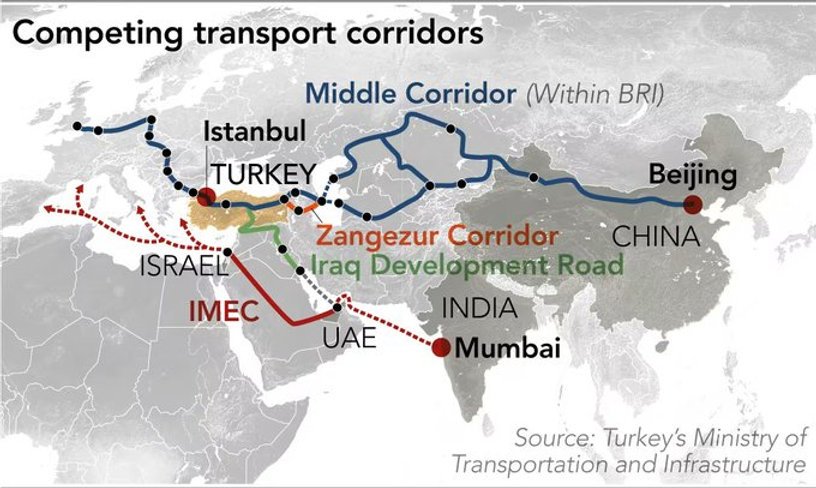
The third layer is transport infrastructure. Russia and Iran have invested in the International North–South Transport Corridor (INSTC), a network of road, rail and maritime routes intended to improve connectivity between Russia, Iran and markets further south. The corridor offers an alternative to established routes that are more exposed to Western pressure, although its commercial capacity remains limited. CSIS estimates place freight volumes along the corridor at around 29 million tonnes in 2025. Estimates also suggest that it carries only a small share of Russia’s containerised foreign trade. Its strategic importance therefore exceeds its current commercial scale.
An Israeli strike on the port of Anzali in March 2026 reportedly disrupted a supply route allegedly used by Russia and Iran to transport ammunition and drones across the Caspian Sea. The extent of the disruption remains difficult to establish, while alternative ports provide options for rerouting cargo. The corridor’s long-term value will depend on investment, infrastructure capacity, border procedures and the ability of both countries to maintain reliable transport links.
Strategic Implications
Iran, Russia and China form a decentralised system that blunts Western sanctions without a formal alliance. Moscow supplies military-technical upgrades and combat feedback in exchange for Iranian drone designs. Beijing supplies a market, payment channels and components. Tehran thereby raises capital and obtains technology that sanctions were meant to deny it. The network also faces significant constraints. Russia and Iran compete for Chinese oil demand, the INSTC handles a limited share of Russian foreign trade, and the war has placed additional pressure on the economic channels through which Tehran earns revenue. The House Select Committee on China has assessed that the 2026 conflict sharply reduced the value of China’s discounted-oil channel, although Beijing is expected to retain an interest in purchasing sanctioned crude. Nevertheless, whether the arrangement endures depends on how the war ends and on whether Washington targets Chinese ports, refiners and intermediaries. Claims that it will permanently reshape the global balance of power remain unproven.