
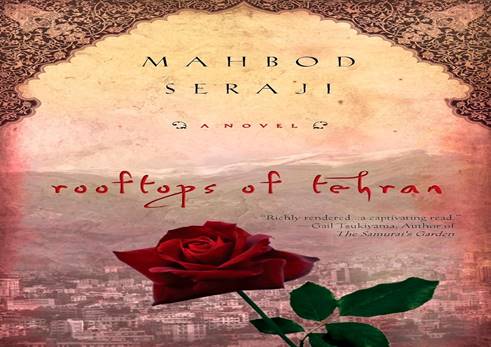
Review of Mahbod Seraji’s Rooftops of Tehran
It was the long summer of restlessness, the youthness asking to colour the clapped mountains in red. Verses of fear and hope tremble the silent heart when Rooftops becomes boisterous. Some pages of history stay with us because of extraordinary events, and others remain as they make ordinary lives unforgettable. Rooftops of Tehran, the novel belongs to the latter. The world that knows Iran and Iranians who live in it is a tale of noisy revolutionary paradox. Readers encounter countries through the headlines, long before they encounter the living ones. Images of revolutions, sanctions, protests, and conflicts often dissuade and distort headlines about the tales of ordinary homes, neighbourhoods, and unheard voices.
Mohbod Seraji’s Rooftops of Tehran was set in Tehran during the turbulent years of the Shah’s regime in the 1970s. The tale of four young souls breathing for freedom, hope, love and fear while awaiting the unknown path. The period was marked by political uncertainty and change. Seraji was born and raised in Iran and later lived in exile in the United States. He writes neither as a detached historian nor as a political commentator, but as a storyteller trying to refurbish a remembered world, collecting what has been lost. It is a story of restless summer, fretful afternoon and a moonless night vividly inquiring the meaning of freedom, the life of young hearts, Pasha, Ahmad Faheema, Zari and their short-lived shared silence. Seraji chooses the perspective of Pasha, a young boy whose memories come through the rooftops and neighbourhoods of his childhood. This retrospective narration invites the feelings, whether Pasha remembers his youth, or was he trying to preserve an idea of Tehran that is forever lost?
For many readers, Iran’s modern history is often encountered through accounts of revolution. Seraji, however, begins elsewhere and beyond the unsettled reality. He introduces them to rooftops, friendships, neighbours, and the ordinary essence of adolescence, where rooftops become observatories, friendships become refuges, and ordinary lives bear the burden of extraordinary events. One of the novel’s most compelling literary devices is the rooftop itself; a symbol of freedom. It acts as more than a mere physical space. It is a place of emotion and meaning reflecting the inner voices of the chosen characters. It emerges as a space between public and private life, between childhood and history itself.
It is here that the main character, Pasha, and his friends dream about their future, observe, fall in love, and share moments of laughter, curiosity, and quiet reflection. In the novel, the rooftop lays out a sense of distance and connection, elevated above the everyday bustle of the streets, a place where the characters can observe the whole world and remain rooted in their own experiences. As the story unfolds, the rooftop becomes a silent witness to the change. What began as a space of innocence and imagination slowly gave way to the harsh realities of a fractured society. Through this transformation, the rooftop mirrors the characters’ journeys from childhood to adulthood. The mere rooftop, in essence, becomes the silent narrator of the whole story, standing as an emotional heart, reminding readers that the most ordinary spaces do hold heartfelt meaning.
The novel unfolds through the rhythms of everyday life, bearing more weight than the political upheavals. Through Pasha’s memories, the story tries to capture a Tehran through friendships, youthful longing, family bonds, and the quiet routines that mould their ordinary existence. Seemingly, these small, personal moments formed the emotional foundation. Through these intimate experiences, the novel addresses the emotional dimension of history. Before she became extraordinary, through conflicts and transformations, she lived in the most ordinary spaces. It forever lives on the rooftops, between the neighbourhood streets, within the simple, ordinary private worlds of individuals. A picture of the city is preserved that may have been overshadowed by the heavy political past.
In Rooftops of Tehran, silence acts as the loudest character. It is not about felt emptiness but a powerful presence. It is that unseen fear in a society where words can be dangerous. But it also allows love and understanding to exist quietly. Seraji uses silence as both protection and expression. It shielded characters from harm and revealed emotions they cannot say aloud. In moments of looseness, silence becomes a shared language; in moments of loss, it deepens grief. Novel’s greatest strength lies in its ability to present history through deep human characters rather than abstract events. Rather than centring the narrative on a single heroic figure, the novel presents the neighbourhood itself as its true protagonist. As a space that tended to people through a mosaic of interconnected lives, families, friends, neighbours, and shared rooftops. Seraji constructs a living community that breathes, celebrates, grieves, and changes together. Pasha, the character, serves as the emotional lens through which readers enter this world, but he never dominates it.
Instead, his memories braid together the lives of those around him, caring for each other. The neighbourhood thus becomes a microcosm in itself. A society on the brink of transformation, where personal stories of people cut through with larger past threads without ever losing their deeply human essence. Within this collective landscape, Zari emerges as the novel’s emotional anchor. She is more than Pasha’s first love. She embodies innocence, tenderness, and the fragile hope that life can continue untouched by the uncertainties gathering around them. It was through her character that I experienced the novel most intensely. The moment she set herself on fire was one of the few instances that compelled me to pause my reading. I found myself unexpectedly in tears, not because Seraji relied on dramatic spectacle, but because he had so patiently cultivated her humanity. Through fleeting conversations, quiet gestures, and ordinary moments, her pain became impossible to witness from a distance. What moved me, therefore, was not the act itself but the painful recognition of how fragile hope can become when it collides with forces larger than the individual.
Memory in this novel has captured nothing as a recollection of the past events, but something as lived. A breathing force between the doors of identity and narrative. Seraji does not present memory as linear or complete. Instead, in fragments of laughter, fear, longing and loss, with a sense of deep reflection from Pasha’s voice. In a way, the novel mirrors the idea that storytelling itself becomes an act of preservation, holding onto something that history tries to erase. What makes this outlook fascinating is the way wounded memory tries to blur the boundary between the personal and the collective. Pasha’s recollections are deeply intimate. These recollections are never isolated from the larger social and political currents engulfing him. On the verge of transformation in the society, each remembered rooftop conversation, each shared silence carries within the weight of it. By narrating the moments, Pasha refuses to let the lives of those around him dissolve into anonymity. In a sense, storytelling becomes an act of resistance and an act of care. Through the act of telling, memory itself becomes a form of quiet endurance.
Rooftops of Tehran remains relevant because it reminds us that history is not made up only of revolutions and headlines. The world of ordinary people lives through love, fear, hope, and loss. Their dreams, fears, and relationships rarely appear in official accounts. It refuses to reduce conflict to an ideology. In doing so, the novel goes beyond its setting. It becomes a timeless reflection on what it means to grow up in a world that is constantly changing and desperate. Long after the political events fade from memory, what remains are the rooftops, the conversations, and the quiet acts of hope that unfolded upon them. Rooftops of Tehran is not just Pasha’s journey; it is a reader’s journey.
***