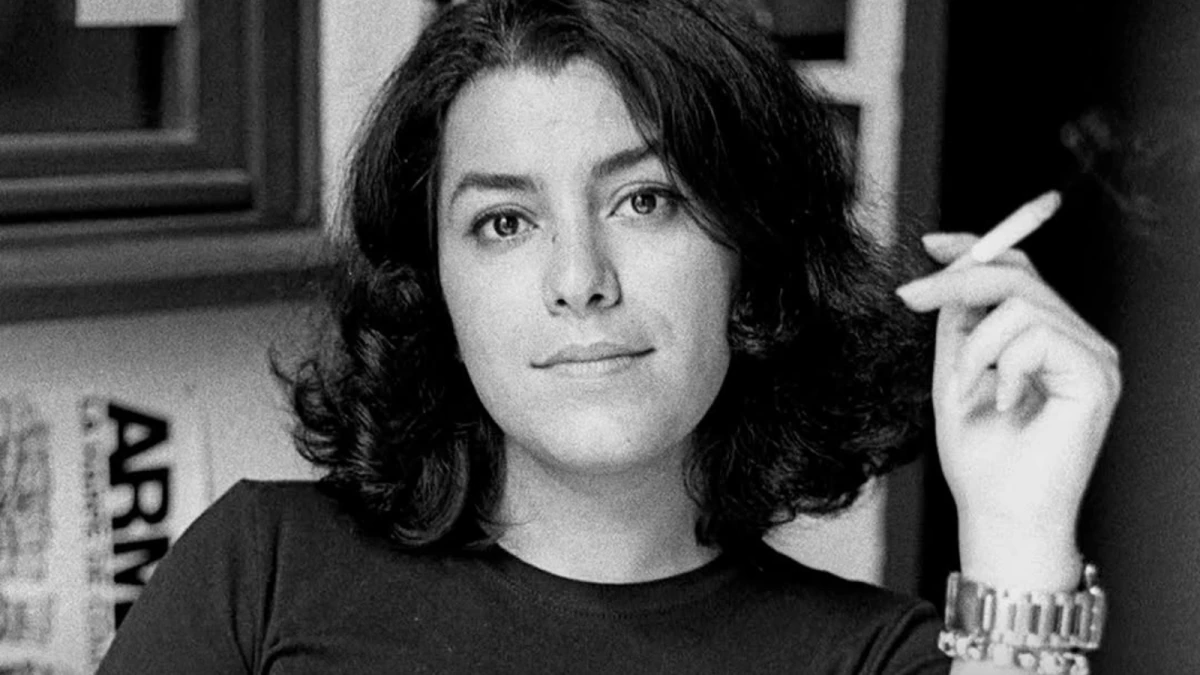
Marjane Satrapi, the French-Iranian graphic novelist, filmmaker, and artist best known for Persepolis, has died at the age of 56. Her family told AFP that she “died of sadness” following the death of her husband, Swedish producer Mattias Ripa, in April last year. Later that month, messages posted on her Instagram account included the words: “For I lost the love of my life.”
Satrapi’s death prompted tributes across France. President Emmanuel Macron praised her as “a great artist who turned her Iranian childhood into a universal tale,” while Yaël Braun-Pivet, president of the French National Assembly, described her work as “an act of freedom” that gave voice to the Iranian Revolution and championed women’s rights.
Born in Rasht, Iran, in 1969 and raised in Tehran, Satrapi moved to Europe as a teenager to continue her education and escape the restrictions of the Islamic Republic. She settled in France in 1994 and became a French citizen in 2006.
Marjane Satrapi is best known for her acclaimed graphic novel series and film Persepolis. The Élysée Palace has praised her for “captivating a global audience” with the work, calling her a leading cultural figure whose art carries a universal message of freedom and immense international renown. Her combination of bold black-and-white drawings and imaginative storytelling became a bestseller. Through her stark black-and-white illustrations, Marjane Satrapi captures the complex, layered realities of both her homeland and her own life. What made her narrative especially significant was the originality of her voice-that of an Iranian woman telling the story of a country so often spoken about, spoken over, and spoken for by others.
Persepolis is a graphic memoir that traces the life of its protagonist, Marjane Satrapi, in pre- and post-revolutionary Iran. Through Satrapi’s childhood experiences, the narrative first depicts life under the oppressive rule of the Shah, marked by political repression and social inequality, and later the restrictions imposed by Iran’s Islamic regime following the 1979 Revolution. As the political climate grows increasingly restrictive, the memoir also follows Satrapi’s life in exile in Europe after her parents come to the painful realisation that contemporary Iran is no longer a place where their daughter can live freely.
She later co-directed the animated adaptation of Persepolis. The internationally acclaimed hit made Oscar history, making Satrapi the first woman ever nominated for the Academy Award for Best Animated Feature.
Satrapi, through her work Persepolis, wanted to humanise Iranians and make Western readers look beyond the sole violence associated with Iran and the Middle East at large. Even the title Persepolis is a deliberate, highly political act of framing. By reviving the ancient, ruined capital of the Persian Empire rather than using the loaded modern markers of “Iran” or “Tehran,” Satrapi is fighting a two-front ideological war. On one side, she dismantles the Western Orientalist gaze that reduces her homeland to fundamentalist caricatures. On the other hand, she subverts the historical revisionism of the post-1979 regime, which seeks to erase the nation’s pre-Islamic past. From the very cover, Satrapi forces us to acknowledge a simple truth: this is not a story about a modern, monolithic “Islamic state.” It is the story of a deeply complex civilisation burdened by the weight of its own immense history.
While Satrapi was widely celebrated for humanising Iranian society for Western audiences, some scholars have argued that Persepolis risks reproducing a liberal, Western-centric narrative of Iran. Critics such as Nima Naghibi contend that the memoir’s global success was partly tied to its resonance with Western expectations about the Islamic Republic, potentially simplifying the complexities of Iranian political and social life. Others, however, have defended Satrapi’s work as a deeply personal memoir rather than a comprehensive political history, emphasising its contribution to feminist and diasporic literature.
The artist was a firm believer in the ideals of freedom and democracy. After more than a decade in France, she gained French citizenship in 2006, but last year she refused the French Legion d’Honneur – the French equivalent of an OBE. Satrapi publicly declined the award due to what she viewed as France’s political “hypocrisy” regarding her homeland- Iran. For Satrapi, accepting a prestigious state award from France while its government continued to compromise and negotiate with the regime terrorising her homeland felt like an act of betrayal to the Iranian people.
Satrapi spent her life using art as an act of resistance. She famously stated that she learned not to be scared because while she had the privilege of living safely in exile, teenagers in Iran were being shot in the streets for demanding basic rights. Refusing France’s highest honour was her way of ensuring her actions aligned perfectly with her fierce, lifelong devotion to freedom.
She also actively supported the protests for freedom and democracy against the regime in Iran. In response to the 2022 protests sparked by the death of Mahsa Amini, who had been arrested by the morality police for an “improperly” worn hijab, she created Woman, Life, Freedom, a collection of graphic stories documenting the movement. Satrapi created her comic books to let young Iranians know they aren’t alone, signalling to them that the outside world hears their struggles and stands in support.
In her moving 2009 New York Times essay, “I Must Go Home to Iran Again,” Satrapi wrote beautifully about the ache of exile, noting that while she loved Paris, “Tehran with all its ugliness will in my eyes forever be the ‘bride’ of all cities.” Watching the 2009 Green Movement from afar, she shifted her outlook on her eventual return, famously concluding: “Once you leave your homeland, you can live anywhere. But I refuse to only die in Iran. I will one day live in Iran… or else my life will have had no meaning.”
Marjane Satrapi’s powerful declaration-“I will one day live in Iran… or else my life will have had no meaning”-stands as a haunting testament to a longing that remained physically unrealised at the time of her death. Like Satrapi, an entire generation of Iranian artists, academics, and political dissidents has spent decades waiting for a political opening that never came. Instead, escalating state repression, mass arrests, executions, and the broader geopolitical turmoil surrounding Iran have made a return a profound risk, not only for those in exile, but also for those still living within the country. Satrapi chose to continue her resistance from afar, using art as a form of political witness and organising collaborative graphic projects that amplified voices from the ground. Yet she never had the chance to inhabit the “bride of all cities” as a free woman.