
For scholars, policymakers and strategic analysts navigating the fragmented architecture of contemporary international relations, the growing adoption of a non-aligned posture by many states is emerging as a consequential diplomatic phenomenon. With its roots in the Cold War era, when the international system was effectively divided between the United States and the Soviet Union, it lost its resonance after America assumed unquestioned dominance of the neoliberal order in the early 1990s. Now that the contemporary international system has gradually assumed a form of multipolarity with the US and China at the top, non-alignment appears to be making its way back into the discourse, including under names like ‘active alignment’ and ‘multialignment’, and reflected in how the middle powers are increasingly rejecting the binary rigidities of alliance politics.
At the same time, this modern iteration of non-alignment is fundamentally different from that of the Cold War era, which was rooted in the legacy of the 1955 Bandung Conference and 1961 Belgrade Summit, and was highly normative, functioning as an ideological crusade against imperialism and superpower bloc politics. It is largely devoid of overarching ideological purity and is highly pragmatic, based on an interest-driven strategy of national survival, designed to maximise strategic autonomy, leverage global multipolarity for developmental gains, and insulate domestic economies from the weaponisation of global supply chains and the financial system.
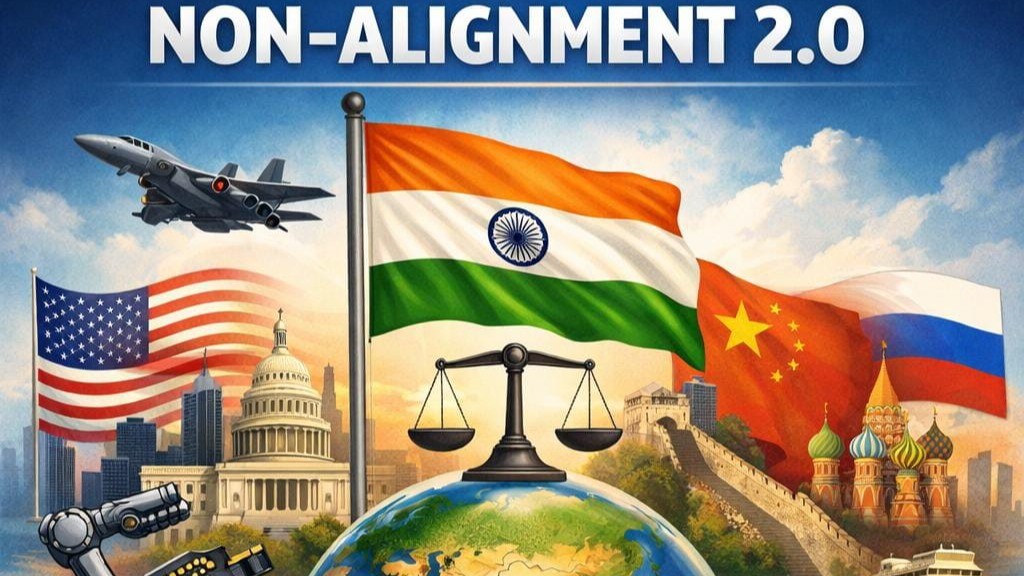
The “Non-Alignment 2.0” appeared in a 2012 policy monograph prepared by several distinguished Indian strategists, which aimed to rearticulate India’s strategic doctrine and define its policy posture during the Cold War era. They distinguished it from its previous philosophical principle of non-alignment by centring geoeconomics as its core locus. As further reinforced by Shivshankar Menon’s 2020 scholarship, this reinterpreted framework reflects a consistent historical objective across various Indian administrations: the preservation of sovereign, independent decision-making power in international relations.
MULTIALIGNMENT AND TRANSACTIONAL DIPLOMACY:
As the global order transitioned into a post-pandemic world, the theoretical framework of non-alignment 2.0 evolved into what is termed “multi-alignment” and “transactional diplomacy”. This paradigm is most prominently articulated by India’s External Affairs Minister, Subramanyam Jaishankar, particularly in his book, The India Way: Strategies for an Uncertain World (2020). Jaishankar outlines a highly transactional approach to statecraft where traditional, rigid alliances give way to issue-based partnerships or ‘frenemies’ designed to meticulously navigate between the competing spheres of influence of the USA, China and Russia.
Multi-alignment operates on the realist logic that in a multipolar world characterised by the diffusion of power, binary allegiances are a strategic liability. Jaishankar clearly articulated this perspective at the Munich Conference 2026, where he argued that nations should be admired for maintaining “multiple options” in their foreign policy. This represents a philosophical break from the Cold War tradition and endorsement of aggressive maximisation of national interests.
THEORETICAL FRAMEWORKS IN THE GLOBAL SOUTH:
Emerging in Latin America as a pragmatic response to the escalating US-China rivalry, Active Non-Alignment (ANA) guides post-colonial nations to prioritise sovereign interests and resist external coercion. A core pillar of this framework is “collective financial statecraft,” which emphasises the need for economic optionality. By diversifying financial partnerships through alternative multilateral institutions—such as the Asian Infrastructure Investment Bank or the New Development Bank—states can avoid economic subordination and diplomatic marginalisation, ensuring genuine strategic autonomy without automatically adopting the stances of great powers.
Parallel to ANA, Southeast Asian middle states utilise a calculated, insurance-seeking strategy known as “hedging” to preserve their independence amidst severe geopolitical uncertainty. Rather than choosing a binary approach of balancing against threats or bandwagoning with rising powers, these nations rely on a complex mix of active neutrality, inclusive diversification, and adaptive offsets. Despite creating friction with superpowers that demand absolute loyalty, middle states will maintain this deliberate ambiguity to ensure their own survival, abandoning it only if faced with absolute strategic certainty or severe domestic threats.
STRATEGIC AUTONOMY IN CONTEMPORARY FOREIGN POLICY:
INDIA: Transactional Pragmatism vs Defensive Duplicity
India serves as the primary example of non-alignment 2.0, utilising strategic autonomy to selectively engage with the Liberal International Order to advance its transformation into a great power without being subsumed by Western structures. In the security realm, particularly following the clash at Galwan, India has adopted the strategy of “limited hard balancing” against China. This involves deepening strategic partnerships across the Indo-Pacific and increasing military operability with the QUAD, while strictly avoiding any formal treaty alliances with the USA.
In the geoeconomic sphere, India has long defied Western pressure to maintain cordial ties with Russia and has heavily imported discounted Russian crude oil, acting as a pivotal “sanctions swing state”. This delicate balancing triggered retaliatory tariffs in 2025 by the USA on Indian imports and strict sanctions on Russian supply chains. While Western critics condemn this posture as opportunistic “defensive duplicity” and point to domestic backsliding as proof of India’s divergence from Liberal values, defensive realists cite it as proof of India successfully maximising economic gains and avoiding foreign entanglement.
INDONESIA: The “Gado-Gado” approach
Under President Prabowo Subianto, Indonesia is aggressively executing a traditional Bebas Atkif (independent and active) foreign policy through a highly dynamic “gado-gado” (mixed) diplomatic strategy. This approach involves oscillating between major global powers, creating a web of seemingly contradictory manoeuvres. On one hand, Jakarta has bolstered Western ties by signing a major defence partnership with Washington and a new security deal with Australia.
Prabowo has simultaneously deepened cooperation with rival powers by prioritising state visits to Beijing, declining a G7 invite in favour of a meeting with President Vladimir Putin, and holding joint naval drills with Russia, and officially joining the BRICS bloc as a partner.
While some Western scholars view this policy as directionless, it aligns perfectly with theories of geopolitical hedging centred on inclusive diversification. By strictly refusing formal alliances, Indonesia avoids entanglement in the great-power rivalry and ensures economic growth. This deliberate balancing act ensures that Southeast Asia remains a multipolar region that rejects zero-sum games, allowing Indonesia to navigate extreme geopolitical pressures.
SOUTH AFRICA: Multi-alignment and historical solidarity:
South Africa’s foreign policy is a sophisticated exercise in multi-alignment, deeply informed by its liberation history, rather than a simple act of “fence-sitting.” By maintaining ties with nations like Russia, China, and Cuba—who supported the anti-apartheid struggle while many Western powers did not—Pretoria prioritises historical solidarity and strategic agency over Western pressure to take sides in modern conflicts.
This independent stance is part of a broader ambition to foster a multipolar world order and inclusive global governance. Despite shifting internal dynamics following the 2024 formation of the Government of National Unity, South Africa continues to assert itself as a proactive regional power, refusing to compromise its national interests or its role in shaping the evolving global landscape.
INSTITUTIONALISATION OF STRATEGIC AUTONOMY:
The pursuit of strategic autonomy by individual states is increasingly being consolidated and reinforced through new multilateral institutions specifically designed to bypass Western structural dominance. The rapid expansion of BRICS, the aggressive push for global de-dollarisation, and the revitalisation of the G-77 are critical operational components of this systemic shift.
BRICS Expansion and Weaponisation of Tariffs:
The 2024 BRICS summit in Kazan, Russia, marked a major expansion of the bloc with the addition of several nations, including Egypt, Ethiopia, Iran, and the UAE. While this growth projects a united Global South and a formidable counterweight to the G7 aimed at reforming global governance and trade, the coalition suffers from deep internal fragmentation. Members harbour competing strategic visions; Russia and China seek to steer the BRICS as an overtly anti-Western vehicle, whereas India and Brazil prefer a non-Western platform focused on institutional reform and strategic autonomy, a dynamic further complicated by ongoing regional rivalries such as the Sino-Indian border dispute.
Despite these internal contradictions, the bloc’s increasing influence and economic initiatives have provoked aggressive push-back from established global powers. During the July 2025 BRICS summit in Rio de Janeiro, US President Donald Trump perceived the group’s efforts to bypass the US dollar and establish a new multilateral guarantee fund as a severe threat. He retaliated with a sweeping 10% tariff on nations demonstrating “anti-American policies” and a punitive 50% tariff on Brazilian imports. This harsh economic response, explicitly aimed at defending the dollar’s global reserve status, validates the expanding bloc’s genuine capacity to unsettle the traditional Western-led global order.
The G77: Reclaiming South-South cooperation
The G77 and China are increasingly leveraging their collective demographic and normative influence to demand a fundamental overhaul of the international financial architecture, specifically targeting the governance of the IMF and World Bank to ensure fairer debt management. Emerging from key milestones such as the 2023 Havana Summit, the coalition emphasises that while South-South cooperation is a distinct sovereign endeavour based on non-interference, it serves as a replacement for North-South relations.
By institutionalising scientific initiatives and strengthening policy organs such as UNOSSC and the South Centre, these nations are building the autonomous capacity needed to challenge established global hierarchies and negotiate more equitably on the world stage.
PRETENCE OR PATH FOR THE GLOBAL SOUTH?
Non-Alignment 2.0 can be termed both a pretence and a path for the Global South. The fundamental driver of this foreign policy posture across Asia, Africa and Latin America is the rational, sovereign pursuit of state survival and domestic economic development in an increasingly hostile and multiplex world. When states engage in “Gado Gado” diplomacy or act as “sanctions swing states,” they are not exhibiting confusion; they are masterfully executing calculated strategies of inclusive diversification and adaptive offsetting. The modern iteration of non-alignment carries deep structural hazards.
The 2025 and 2026 tariff wars illustrate that strategic neutrality provokes aggressive economic coercion from dominant nations seeking to block the creation of rival financial systems. Moreover, internal conflicts within alliances such as BRICS+ routinely compromise their effectiveness, revealing underlying divisions in the Global South.
Ultimately, the opportunistic and deal-driven style of this diplomacy often justifies critiques of moral inconsistency. Rather than withdrawing from the world stage, Non-Alignment 2.0 allows the Global South to reshape its integration into the global system actively. By rejecting a new bipolar divide, these nations use strategic autonomy to ensure future international relations are defined by flexible, multi-aligned partnerships rather than rigid historical alliances.