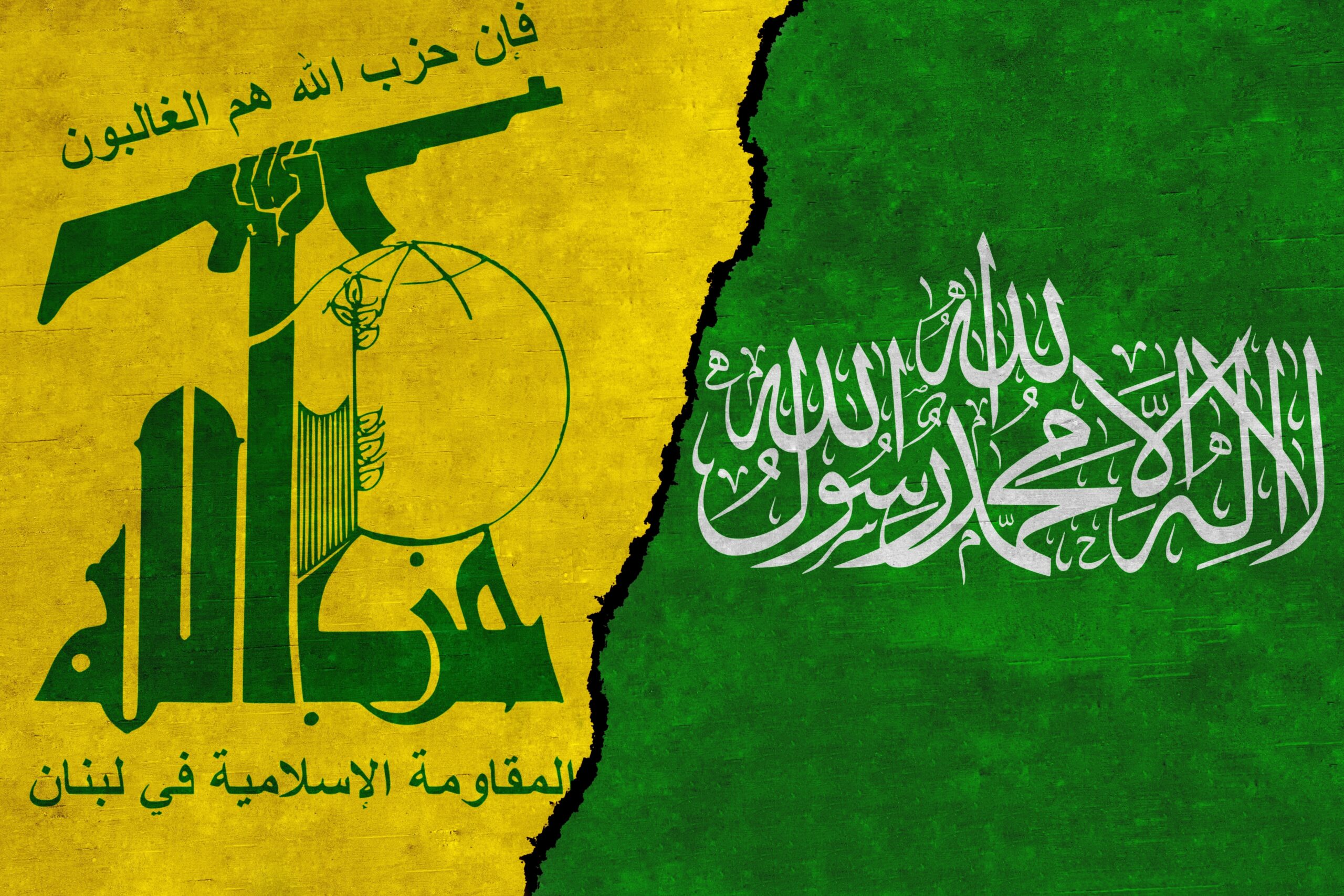
The near-simultaneous US-led campaigns to disarm Hamas in Gaza and Hezbollah in Lebanon have fostered a prevailing analytical assumption: that Hamas is either currently following or is expected to follow Hezbollah’s trajectory of maintaining an armed wing within a negotiated political framework. Resolution 2803 (November 2025) authorised an international force to oversee Gaza’s demilitarisation, Trump’s “Board of Peace” made Hamas’s disarmament a central goal, and US envoy Tom Barrack has pressed for Hezbollah’s disarmament in Lebanon since the November 2024 ceasefire. While the surface symmetry of these efforts invites the assumption that a uniform policy dynamic is at play, this analysis demonstrates that this inference is fundamentally flawed. Once the two cases are disaggregated across their political, organisational and institutional dimensions, the Hezbollah analogy explains little about how, or whether, Hamas will disarm.
The argument is analytical rather than normative. The case for disarming Hamas is well established: its 7 October 2023 assault killed roughly 1,200 people in Israel and took some 250 hostage, the movement remains a proscribed terrorist organisation in the United States, the European Union and elsewhere, and from an Israeli security standpoint, an armed Hamas constitutes a recurring threat. The war has also devastated Gaza, where tens of thousands have been killed and most buildings destroyed. The question examined here is narrower: not whether Hamas ought to disarm, but whether the Lebanese experience offers a reliable guide to the outcome.
Structural Divergences: State Authority vs. Occupation
The analogy rests on an implicit premise: that Hamas and Hezbollah occupy sufficiently similar positions for one to model the other. That premise can be tested against three dimensions on which the two movements might be expected to align, namely the politics of legitimacy, organisational form and the institutional environment, in determining whether disarmament would occur. On each, the evidence points to divergence rather than convergence.
The two disarmament debates concern fundamentally different political stakes. In Lebanon, the dispute is over who should exercise sovereign authority within an existing state. President Aoun’s insistence on a state monopoly of arms is a euphemism for disarming Hezbollah, and it enjoys substantial domestic support: Gallup polling conducted in mid-2025 recorded large majorities of Christians, Druze, and Sunnis favouring the confinement of weapons to the national army, with only the Shia community dissenting. When the cabinet endorsed the disarmament goal in August 2025, the Hezbollah and Amal ministers walked out.
In the Palestinian case, the dispute concerns the existence of sovereignty itself. PCPSR polling in October 2025 found approximately 70 per cent of Palestinians opposed to disarmament even as a condition for ending the war. Whether grounded in objective reality or collective political consciousness, this public belief represents a critical baseline that any viable disarmament framework must navigate. Survey evidence suggests that Palestinians attribute their compromised sovereignty to military occupation rather than to Hamas’s arsenal; on this reading, the weapons are understood as a response to the absence of self-government rather than an obstacle to it. A movement negotiating its status within an established state and a movement resisting under foreign occupation are not situated in the same way.
Organisational Logics: Conventional Territoriality vs. Dispersed Resilience
The movements’ military structures are close to inverse. Hezbollah functions as a territorial force, holding fixed ground below the Litani River and embedding armed capacity within a sprawling network of social provision and municipal infrastructure. Hamas, by contrast, derives its resilience from dispersal: its decentralised command has absorbed sustained leadership losses since 2023 without organisational collapse. This structural divergence bears directly on the limits of the policy analogy. A Hezbollah-style settlement would require Hamas to adopt a fixed, semi-conventional posture, precisely the configuration that would forfeit its principal military and survival advantage. Consequently, organisational incentives actively militate against copying the Lebanese framework rather than encouraging it.
Furthermore, regional patron dynamics reinforce this divergence. Iran’s strategic calculation about Hezbollah involves maintaining a potent, forward-deployed deterrent along Israel’s northern frontier within a quasi-state architecture. In contrast, Hamas runs within an isolated enclave subject to absolute blockade, altering the calculus of supply, command continuity, and long-term sustainment.
The Institutional Void: Integration vs. Unilateral Demobilisation
The institutional setting determines what disarmament can actually mean in practice. Hezbollah operates within an internationally recognised state with a functioning parliament, a cabinet, bureaucratic ministries, and regularised electoral processes; disarming it is, in principle, a matter of integrating an armed faction into an existing political order.
Hamas governs in the absolute absence of such structures, operating without a recognised sovereign state, a unified security apparatus, or a consolidated national authority, and entirely under conditions of active occupation and blockade. In this environment, disarmament cannot denote integration into a state, because no such sovereign state exists; it denotes unilateral demobilisation in advance of the very sovereignty that Palestinians treat as its necessary precondition. The exact same political term is thus being used to describe two categorically distinct undertakings.
The Historical Baseline and Policy Implications
The Lebanese case is instructive less as a cautionary parallel than as a sobering empirical base rate. Successive internationally backed efforts, including the 1989 Taif Accords, Resolution 1701 with its 15,000-strong UNIFIL deployment, and the 2023–24 war that killed more than 4,000 people in Lebanon, have failed to dislodge Hezbollah’s arsenal, despite the presence of an existing state framework to absorb the movement and majority public support for disarmament.
Where these comparatively favourable conditions have not produced durable disarmament, Gaza presents significantly weaker ones: broader popular support for retained arms, and total occupation in place of a domestic sovereign rival. The historical record thus offers little structural basis for expecting imposed disarmament to succeed more readily in Gaza than it has in Lebanon.
Two critical qualifications temper the argument. First, the finding is conditional on present circumstances; a credible, internationally backed pathway to Palestinian statehood, a marked decline in public support for armed factions, or a voluntary shift by Hamas toward a purely civilian governing posture would alter the assessment. Second, the analysis should not be read as an uncritical defence of an armed Hamas. An entrenched, autonomous militia carries substantial risks, for Palestinians as well as Israelis, and the security concerns motivating the international disarmament demand are entirely legitimate. The claim is more limited: that the policy instrument currently on offer is profoundly misaligned with the structural conditions it confronts.
Conclusion
Disaggregating the two cases indicates that the Hamas-Hezbollah analogy obscures more than it clarifies. The movements differ fundamentally in the object of their political disputes, in their underlying organisational logics, and in the institutional environments governing disarmament, and the Lebanese record suggests that imposed disarmament rarely endures even under far more permissive conditions. For policymakers, the core implication is that Lebanon is an unreliable template: durable disarmament in Gaza is unlikely to be engineered ahead of the political settlement on which it depends. The central task there is not the reintegration of a militia into a pre-existing state, but the arduous construction of a sovereign state in the catastrophic aftermath of war.