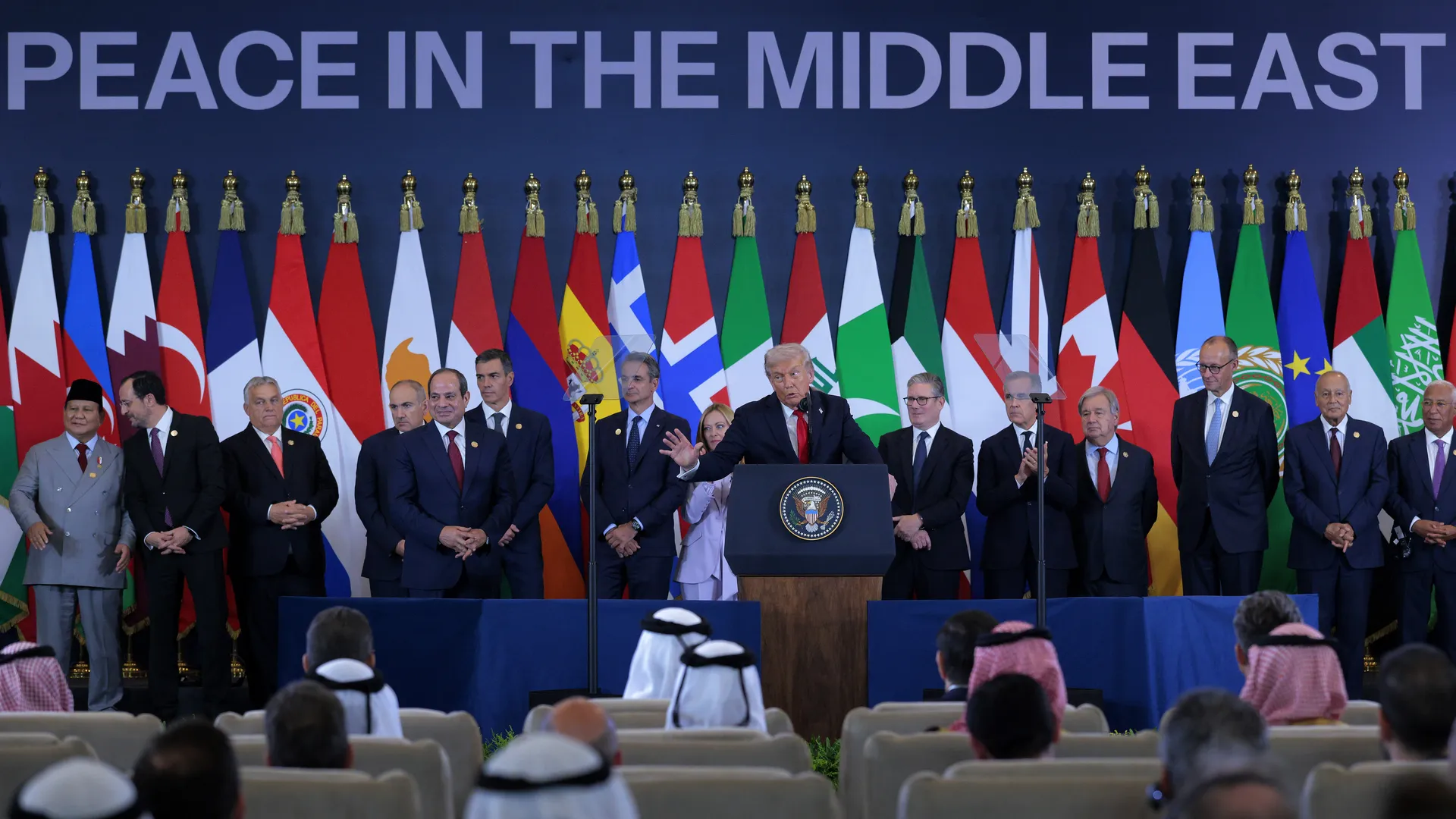
U.S. President Donald Trump’s “Comprehensive Plan to End the Gaza Conflict” has been sold as the exit ramp from Israeli-unleashed ruins of Gaza following the 7 October 2023 attacks by the Palestinian Hamas. It is an externally supervised peace plan pairing ceasefire monitoring with demilitarisation, interim administration, and a reconstruction drive managed through an international “Board” model. The plan pitch is seductive as it promises to bring order, money, and a fast-track normalcy to Gaza, where humanitarian needs remain acute after its ‘genocidal’ devastation by Israel for two years. According to the United Nations Office for the Coordination of Humanitarian Affairs (OCHA), nearly all Palestinians in Gaza require basic humanitarian aid like food, water, shelter, and care, even as its devastated infrastructure and logistics constrain access.
But the central problem remains: peace cannot be reduced to a technical package of reconstruction and oversight. The risk with externally designed governance arrangements (no matter how well intentioned) is that they may inadvertently replicate the very dynamics that fuel protracted conflict when they prioritise administrative order over political agency. Yet, peace cannot be reduced to a technical package of reconstruction and oversight.
This distinction has deep roots in conflict theory. Political scientist Edward Azar’s Protracted Social Conflict framework argues that enduring conflicts are not merely the result of material scarcity or violence; they stem from unmet deep nonmaterial needs such as security, identity, recognition, and political participation. Conflicts become “protracted” not because violence persists, but because the core political grievances that underpin it remain unaddressed. Gaza’s long history of contested legitimacy and exclusion fits this pattern, not just for Palestinians inside the territory, but for the wider Palestinian polity.
In this light, peace defined solely by ceasefires and reconstruction becomes problematic because it foregrounds conflict management, containing violence and stabilising conditions, while deferring the more challenging task of conflict resolution or transformation, which demands political inclusion and structural change. This theoretical distinction is emphasised in the work of John Paul Lederach, a leading scholar of peacebuilding, who argues that durable peace hinges on building sustainable relationships, local capacity for self-governance, and social legitimacy, not merely on templates imposed by external actors.
In Gaza today, these concerns are tangible. Plans for interim governance emphasise technical functions, security coordination, border oversight, and aid administration, but leave questions of political authorship largely unresolved. For example, discussions about international or regional oversight of Gaza’s crossings and aid flows highlight the potential for administrative control to overshadow political agency. This risk is compounded by ongoing constraints on movement and essential resources: the Rafah crossing, a crucial lifeline for humanitarian access and commerce, remains conditionally closed despite repeated international calls for its full reopening.
The human consequences of sidelining political agency are profound. Gaza’s health system, already devastated, continues to face severe shortages, with thousands awaiting medical evacuation and basic treatment. Families affected by displacement, loss of homes, and repeated trauma must navigate not only physical reconstruction but the reconstruction of dignity and identity, dimensions that are hard to quantify but essential to long-term stability.
The absence of mechanisms for recognition and redress also perpetuates political grievance. Despite the ceasefire framework, families affected by the conflict continue to seek acknowledgement of their suffering and avenues for meaningful restitution. Regional actors such as Egypt, Jordan, and Qatar have publicly condemned violations of the ceasefire and stressed that political and humanitarian progress are inseparable, implicitly recognising that failure to integrate political legitimacy into peace processes will undermine stability.
International experience suggests that when transitional arrangements privilege external management over local legitimacy, post-conflict societies often relapse into volatility. Imposed architectures may deliver short-term order, yet struggle to build the social trust required for durable peace because suppressing violence does not resolve the political roots. UN peace operations offer instructive lessons: facilitation and locally anchored bargains tend to endure longer than prolonged trusteeship. In Bosnia and Herzegovina, Dayton’s imposed architecture ended mass violence but entrenched ethnic vetoes and paralysis. In post-2003 Iraq and post-2001 Afghanistan, externally engineered institutions looked functional on paper but lacked social authority, feeding insurgency like a reminder that when identity, dignity, local ownership, and recognition are deferred for external control and reconstruction, conflicts mutate rather than resolve.
A more credible peace framework for Gaza must therefore be anchored in inclusive political agency and local legitimacy. This means meaningful participation of Gazan civic actors, such as municipalities, nongovernmental organisations, labour networks, women’s and youth groups, in decision-making from the earliest stages of governance planning. It also means recognising that rebuilding social institutions, restoring civic participation, and creating space for accountable political representation are as critical to peace as reconstructing roads, hospitals, or utilities.
This approach aligns with Lederach’s notion of conflict transformation: peace is not merely the absence of violence but a process of rebuilding relationships and social trust. Without this orientation, governance frameworks risk devolving into technocratic oversight mechanisms that restore services but leave political disenfranchisement intact, a fertile ground for future instability.
The question facing regional and international policymakers is not whether Gaza should be rebuilt; the answer must be yes. Reconstruction is imperative. The question is how it should be rebuilt: as a political community with agency, dignity, and a voice in its own future, or as a territory governed indefinitely under technocratic supervision?
International donors and mediators, from the United States and European states to Gulf partners and regional institutions, must recognise that lasting peace is not delivered through managerial packages. A genuinely sustainable peace for Gaza will depend on processes that empower the people most directly affected, uphold political legitimacy, and address the deep needs that protracted conflict theory identifies as central to durable resolution.
The views expressed in this article are the authors’ own and do not in any way represent Middle East Outlook.