The current instability brought on by the explosion of bilateralism in international trade ties has touched every country in the world. Neo-mercantilist trading practices are on the rise as multilateral trade agreements weaken. In order to formalise bilateral trade policy and prevent mercantilist trading orders, it has led to a wave of bilateral free trade agreements (FTAs) among various nations. The expense of international trade has increased as a result of these tendencies. Additionally, it results in tariffs on non-member nations rising significantly above the current rates, while disregarding tariff concessions granted to member nations based on other factors, such as preferential treatment for developing and impoverished nations.
As a result of US-led tariffs and the growing trend of bilateralism in the evolving global order, India has adjusted its trade relations to establish stronger formal ties with the rest of the world. Except for China, India has bilateral free trade agreements (FTAs) with every member of the Regional Comprehensive Partnership Agreement (RCEP). India’s recent trade diplomacy exhibits a distinct pattern: while the largest prizes remain difficult, contentious, and politically charged, practical, incremental agreements with smaller partners are progressing. India is moving forward where it can, with quicker and smaller agreements with Gulf States, as well as market access victories with sensible nations like New Zealand. Since both parties would benefit from an agreement, negotiations with the EU are nearing completion.
This article examines the applicability of FTAs in light of the mercantilist threat. To prevent mercantilist exploitation of the marginal benefits of a bilateral free trade agreement, this essay highlights why India needs to diversify and expand its manufacturing capabilities along multiple lines. It also contends that expanding bilateral free trade agreements can contribute to reducing conflicts and augmenting peace across continents.
Free Trade Agreements in Response to Mercantilist Threats
In a global economy that is interdependent, mercantilist reasoning has become more prevalent. The original mercantilists were traders from past empires who assessed their power by the amount of gold and silver they could hoard: sell more, import fewer, and retain the wealth domestically. Today’s neo-mercantilists have the same instinct; instead of hoarding bullion, they hoard money, technology, and production capacity. Innovation and technology have evolved into a new kind of accumulation under neo-mercantilism. According to the theory of competitive advantage, poorer regions are often left behind due to technical weaknesses and denial when technical efficiency becomes the sole objective. As a result, technology is used as a weapon in neo-mercantilism. Narratives of capitalism that are mercantilist or neo-mercantilist encourage the state and market to work together for mutual gain. In an interconnected global society, it thus turns economic dependency into a weapon.
Instead of merely growing trade, states are increasingly seeing one another as tools to strengthen political ties. Neo-mercantilist trade weaponisation is powerful and puts international trade to the test of endurance, rather than merely relying on regulations. Today, mercantilist tools of power, such as economic coercion and technological imperialism, are employed to challenge borders, in addition to military force. The adage that “rules without enforcement mean little” predated the slow collapse of multilateralism. Norms are important, but only until they are subordinated to power. The norm violations of a multilateral arrangement indicate the instability of the current global economic order. Furthermore, bilateral agreements between rich and developing nations are more vulnerable to norm violations.
Nonetheless, free trade agreements (FTAs) provide a forum for nations to discuss the marginal benefits and costs of specific goods and services. However, empirical studies indicate that FTAs typically formalise already existing, significant bilateral flows rather than generating new trade. By rearranging winners (exporters) and losers (businesses competing with cheaper imports), a free trade agreement (FTA) rationalises the zero-sum game of trade relations. As a result, FTAs frequently define and change the trading environment within acceptable bounds. FTAs also provide a forum for collaboration in sectors where the World Trade Organisation (WTO) has had difficulty, such as investment, services, and other WTO-plus obligations. These, however, require more involvement and enable types of integration that are currently unattainable through multilateral systems.
However, market and competition freedom are also absent from today’s bilateral free trade agreements. Instead of taking economic factors into account, these free trade agreements are negotiated as an instrument of foreign policy. These are negotiated under the strategic objectives of the governments rather than between trading businesses. The relevance of these free trade agreements is continuously called into doubt by the state’s proactive intervention in trade dealings. Along with economic preferences, FTAs often represent foreign policy interests. As a result, they no longer have the meaning of their nomenclature. To establish economic ties with a wide range of nations, India must grow and specialise in several industry lines. It will help India forge cordial economic ties that can mitigate the negative effects of relying too heavily on a single market.
Enhancing Free Trade Relations through a Strategic Diversification of Production Lines
The political and economic risks are also mitigated and dispersed through the diversification of FTAs. In the words of 19th-century French economist Frederic Bastiat, “when goods do not cross borders, soldiers will,” it leads to doux commerce—business relations among nations that civilise people and make them peace-loving. The reasoning is that trade provides nations and regions with the space and motivation to work towards peace. India is increasingly depending on negotiating additional free trade agreements (FTAs) and diversifying its bilateral economic relationships to lessen its reliance on a small number of nations and prevent conflict with any one of them as commerce becomes more fragmented, weaponised, and politicised. For instance, by entering new markets and adapting to intricate regulations, such as value-added criteria under US tariffs, exporters are already reducing their reliance on the US. India is pushing for sector-specific value chain efficiencies as free trade agreements (FTAs) approach. Indian companies have advanced up the value chain, providing specialised, engineered products in areas with high switching costs and supply chain-wide tariff consequences.
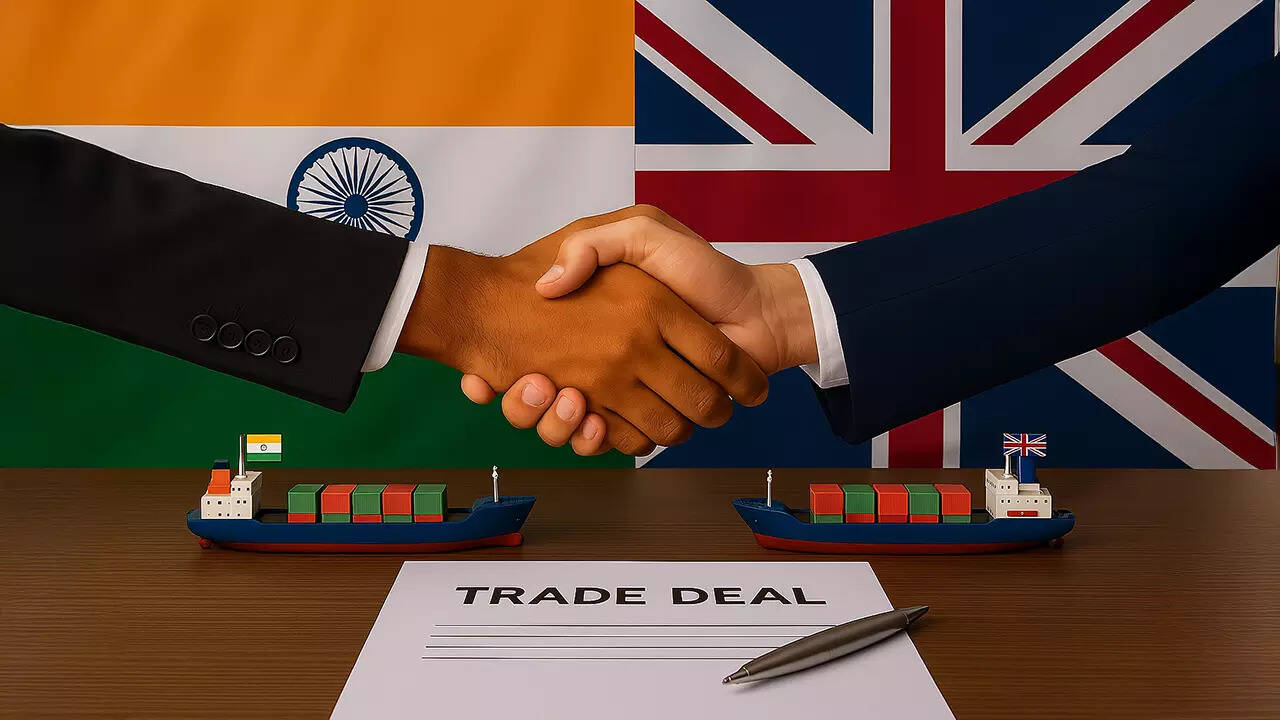
However, price and income have had some impact on India’s exports. Despite the higher tariff, the value-added, income-sensitive exportable goods allow for the exploration of value chain efficiency and competitive pricing. For instance, in November 2025, India’s overall exports to the US unexpectedly increased by 29% year-over-year (y-o-y), despite the US imposing an additional duty on Indian imports. The exports of petroleum products have increased by 207.5%, while telecom instrument shipments to the US increased by 211%. However, labour-intensive industries such as textiles, jewellery, gems, and marine products are particularly sensitive to pricing because consumers can readily shift to products from other countries. These goods may find a market through the India-UK Free Trade Agreement (FTA), which creates enormous export prospects for labour-intensive industries like textiles, marine products, leather, footwear, sports goods and toys, jewellery and gems, and other significant industries like engineering goods, auto parts and engines, and organic chemicals. Thus, diversification of bilateral free trade agreements (FTAs) balances the trade profile.
Conclusion
India’s economic diplomacy must enter into an increasing number of bilateral free trade agreements (FTAs) to access a diverse market for its income- and price-sensitive goods in a world where power, rather than regulations, increasingly drives commerce. Moreover, it prevents a single country from engaging in mercantilist practices. Additionally, due to the lack of substantial economic benefits, these bilateral free trade agreements aim to capitalise on the marginality of production costs. Even though there would be no appreciable profits from trade, bilateral free trade agreements (FTAs) rationalise and codify the rules of economic participation, preventing mercantilist exploitation of the marginality of trade benefits. Furthermore, as the multilateral world order declines, these bilateral free trade agreements compel countries to align their economic interests to prevent conflict in this precarious global order.