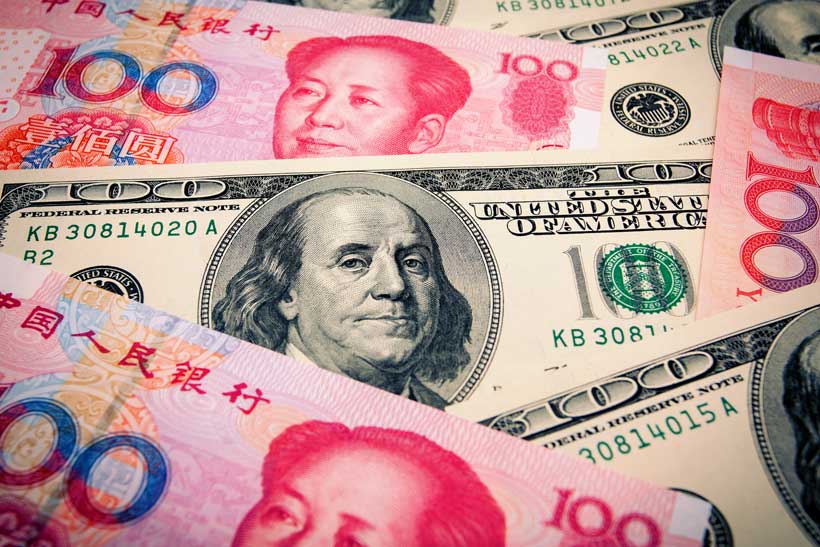
At the World Economic Forum in Davos, Canadian Prime Minister Mark Carney reflected on a hegemonic world order where economic integration risks mutating into subordination. His remarks that one cannot “live within the lie” capture a growing unease: when the architecture of global trade is anchored in a single dominant currency, interdependence can slide into hierarchy. The US dollar’s entrenched reserve status has long shaped this asymmetry, embedding what critics describe as “dollar imperialism” into the fabric of the global economy.
Today, as strategic rivalry intensifies between the United States and China, debates over currency power are no longer theoretical. The question is not merely whether the dollar’s dominance is eroding, but whether its structural role is itself destabilising the global order and whether the alternative could be a different form of monetary hegemony.
Geoeconomics of the Petrodollar Crisis’s Spiral
The dollar’s supremacy rests on three pillars: trade invoicing, global payments, and reserve holdings. About 96 per cent of trade in the Americas, 74 per cent in the Asia-Pacific area, and 79 per cent in the rest of the world is denominated in the currency. About 60 per cent of international and foreign currency claims (mainly loans) and liabilities (mostly deposits) are in US dollars. Its proportion of foreign exchange transactions is roughly 90 per cent. Approximately 60% of the world’s official foreign reserves are in US dollars.
Furthermore, in Q1 2025, the US dollar’s percentage of global foreign exchange reserves dropped to 53.6%. Additionally, the 50-year security agreement with Saudi Arabia, under which oil was priced only in dollars and surpluses were invested in US Treasury bonds in exchange for military protection, expired in 2024. This could result in a shift toward accepting different currencies, albeit it won’t happen right away. Additionally, countries like Russia, China, and Iran are increasingly using non-dollar currencies for energy trade, aiming to reduce reliance on Western financial networks.
To achieve its geoeconomic goals, US authorities have sought to preserve the dollar’s status as a reserve currency in several ways, compensating for economic weaknesses, such as a lack of competitiveness. The US appears to be addressing the growing trade deficit by maintaining the dollar as the world’s currency and matching China’s hegemony over rare earth elements. The US’s current dominance over the trade regime is largely due to dollar-based trade. The oil trade in dollars gives the US significant influence to shape geopolitics globally, both bilaterally and multilaterally, as oil holds a premier position in the international trading landscape. One commodity (oil) and one currency (the US dollar) can both destabilise and stabilise the global price system. Its “as good as gold” quality can only be maintained in a world where the dominant currency is no longer associated with gold if it is associated with oil, that is, if wealthy people have faith that oil prices won’t continue to rise relative to the US dollar. The US gains influence over the oil trade by controlling the petro-dollar trade.
The post-1971 order, which followed the collapse of the Bretton Woods Agreement, effectively replaced the gold-dollar standard with an oil-dollar nexus. The US is under pressure to control oil sources, which it does through coercion or persuasion, to maintain wealth-holders’ faith in the value of the dollar, without which the global economy will experience severe financial turmoil, particularly given the ongoing US current account deficit. In a nutshell, war is a result of today’s necessity to preserve US financial stability. It does, however, produce a spiral effect. To control a significant oil source for financial stability, the US attacked oil-rich Iraq and, more recently, Venezuela. However, as a result of the opposition this strike provoked, oil prices skyrocketed, increasing the threat to financial stability and the temptation to wage war on other oil-rich nations like Iran. Additionally, the US would experience the same spiral consequences in a much more severe form if it decided to go to war with Iran.
The Reserve Currency and Trade Deficit “trade-off”
The dollar’s structural advantage also carries a paradox. The “impossible trinity,” articulated by economists Robert Mundell and Marcus Fleming, holds that a country cannot simultaneously maintain free capital mobility, a fixed exchange rate, and independent monetary policy. Complementing this is the Triffin dilemma, named after economist Robert Triffin which states that a nation issuing the global reserve currency must supply liquidity to the world, typically by running persistent current account deficits.
However, trade imbalances are thought to be self-correcting. A nation’s currency is predicted to lose value when it has a trade imbalance. Exports will then rise, while imports will fall, reducing the trade deficit. However, as the dollar is the world’s reserve currency, this idea does not apply to the US economy. A large portion of a country’s foreign exchange reserves is invested in US government securities. As a result, the dollar is overpriced. A chronic trade deficit results from higher imports and lower exports due to an overpriced dollar. Therefore, the US has a trade deficit not because it imports more goods, but rather because it supplies the world’s reserve currency.
In the face of “unfair” trade and an overpriced currency, how can the US bring manufacturing back and lower the country’s trade deficit? Enter duties on imports. Tariffs will reduce imports and raise their costs, thereby lowering the trade imbalance. By shielding American manufacturers from import competition, they will promote domestic production. However, the US’s return to a more protectionist policy through tariffs has led to increased bilateral commerce in non-dollar currency. For instance, India-Russia oil trade and China’s increasing use of bilateral currency swaps with its trading partners have raised major concerns about the US’s reserve currency supremacy. Moreover, it caused a spiral effect. For example, the reserve currency of the central banks has become less dollarised as a result of the recent US policy of reciprocal tariffs to safeguard trade transactions in dollars. It promotes asking about options for a reserve currency basket and the possibility of de-dollarisation.
Trump has made no secret about retaining the US dollar’s global supremacy, even threatening the BRICS nations with 100% additional tax should they move forward with a unified currency to “degenerate” and “destroy” the dollar. After all, de-dollarisation has the potential to tip the scales against the United States and reduce its capacity to influence international financial markets and the global economy. Furthermore, to protect the dollar’s dominance from the threat of renewable energy, the US withdrawal from India’s solar alliance must be considered.
Economists fear that tariffs go against the concept of economic efficiency. Tariffs, they warn, will lead to higher costs for American consumers, higher inflation, and an inefficient manufacturing sector. Moreover, tariffs will encourage nations to undermine the dollar’s standing as a reserve currency by making imports more expensive. It will portend the trading of multiple currencies. Nevertheless, while the dollar’s dominance persists, China’s control over rare earth elements (REEs) which are critical inputs for advanced electronics, defence technologies, and renewable energy introduces a new dimension to geoeconomic competition. By dominating REE supply chains and expanding semiconductor capabilities, Beijing acquires strategic leverage that parallels the US’s historical advantage in oil-dollar linkages.
However, resource dominance alone does not confer reserve currency status. The Chinese yuan still faces constraints, including capital controls, limited financial transparency, and underdeveloped bond markets. Nonetheless, incremental internationalisation through cross-border payment systems and energy trade settlements signals Beijing’s long-term ambitions. The emerging rivalry thus juxtaposes two forms of structural power: US monetary centrality and Chinese industrial-resource dominance.
Toward a Multipolar Currency Regime?
The core argument advanced here is not simply anti-dollar; it is anti-monopoly. Any single currency’s supremacy risks converting interdependence into hierarchy. A genuinely multipolar world order may require a diversified currency ecosystem in which trade and reserves are distributed across multiple currencies rather than concentrated in a single one. But the current system reflects the US’s actual geoeconomic strength: the acceptability of its currency as a global reserve and its control over one of the most traded commodities, oil.
The rise of China and the evolving structure of international trade are changing the dynamics of this area, even as the US dollar remains the most important reserve currency. However, there wouldn’t be any surpluses to invest or deficits to finance if trade were more balanced over time, which would lessen the demand for a reserve currency like the dollar. The world appears to be moving towards a multi-currency system for harmonious commercial ties. By encouraging alternative payment methods among trading nations and by choosing the currency used for the IMF’s reserve holdings, for instance, it is necessary to end the US monopoly over currency arrangements. The structure can be extended to incorporate trading blocs, in which imbalances net out across members when aggregated. It suggests a world with several reserve and trade currencies.
This bilateral or multilateral currency autarky might unleash the potential for free trade and for emerging economies to obtain investment capital. Moreover, this strategy is embedded in the evolving industrial structure driven by economic sovereignty. Meanwhile, the US’s capacity to finance its ongoing budget and trade deficits would be impacted by the dollar’s declining value. Dollar interest rates may have to climb, and the currency may depreciate. The role of its capital markets and financial institutions would shrink. It would give more space for the formation of a multipolar currency regime.