
History is never a neutral archive of bygone events but is rather a political resource. It has been used by nations to revisit and reinterpret their past not only to honour memory but to reimagine their identities and power aspirations. In this context, Saudi Arabia’s decision in 2022 to designate 22 February as “Founding Day” marks far more than the addition of another public holiday and signals a strategic re-articulation of its origins, legitimacy, and future trajectory.
Even though the Kingdom was formally established as a unified political entity as it exists today in 1932, it possesses a three-century political lineage through the Al Saud family’s rule that predates the modern state system in the Middle East. Until recently, however, Saudi Arabia officially commemorated only its National Day (23 September) to mark the Kingdom’s 1932 proclamation, alongside the two Islamic festivals of Eid al-Fitr and Eid al-Adha. However, in January 2022, a royal decree by King Salman bin Abdulaziz Al Saud introduced Founding Day (22 February), followed by the designation of 11 March as Flag Day in 2023. These additions have expanded the symbolic architecture of Saudi nationalism.
This year’s commemoration marks three hundred years since 22 February 1727, the date on which Imam Muhammad bin Saud laid the foundation of the First Saudi State by assuming the leadership of Diriyah. While 1727 is now presented as the state’s point of origin, this interpretation represents a deliberate departure from an earlier narrative that located the founding moment in 1744, when Muhammad bin Saud allied with the reformer Imam Muhammad bin Abdul Wahhab. The shift from 1744 to 1727 is not a mere chronological adjustment, but reflects a deeper transformation in Saudi Arabia’s national story.
Between the First Saudi State’s Establishment in 1727 and to Charter of Diriyah in 1744
Understanding the significance of the First Saudi State’s establishment in 1727 underscores the need to revisit the prevailing political consternation of the early 18th century. At that time, the Arabian Peninsula, particularly the central region of Nejd, lacked unified authority, with tribes and modest city-states constantly at war over control of vital resources such as water, pastures, and caravan routes. Chroniclers such as Uthman ibn Bishr (1796–1873) describe cycles of drought, such as in 1716, 1724, and 1725; plague in 1726; and internecine conflict that eroded social cohesion.
The city of Diriyah itself suffered from internal rivalries and was divided into two main factions: ‘Ghusaybah’ (dominated by the Rabiah clan) and ‘Al-Mulaybid’ — base of the Muqrin family from which emerged the Al Saud family through Saud bin Muhammad bin Muqrin, the father of Muhammad bin Saud, the founder of Al Saud rule. While this atmosphere of pervasive hopelessness and vulnerability required a leadership that was more than martial prowess and demanded administrative capacity and coalition-building, Muhammad bin Saud’s establishment of his authority in Diriyah starting 22 February 1727 marked a departure from the purely tribal politics of the Arabian Peninsula. His first achievement was transforming the divided areas of Diriyah into a strong, unified city. He consolidated divided quarters, secured trade routes, and brought economic stability to the region. He instituted fiscal mechanisms by establishing a ‘Bait-ul-Mal’ (public treasury) through which Zakat and taxes were collected.
What emerges from this period is an early experiment in state formation: the transformation of local authority into structured governance. By foregrounding 1727, contemporary Saudi historiography highlights this political maturation rather than the subsequent ideological alliance of 1744 under the Charter of Diriyah between Muhammad bin Saud and Sheikh Muhammad bin Abdul Wahhab, which cast the Saudi state as essentially a byproduct of “Wahhabism.” According to Saudi sociologist Khalid Al-Dakhil, reducing the history of the Saudi state to a mere religious movement or a “war against polytheism (Shirk)” diminished the stature of the state itself. This rewinding of history from 1744 to 1727 aims to establish the narrative that when Ibn Abdul Wahhab arrived in Diriyah, a stable, thriving, economically prosperous, and politically and militarily independent state already existed there, something that earlier historians like Ibn Ghannam (1739–1811) and Ibn Bishr (1796–1873) have been accused of overlooking out of religious devotion.
Crown Prince Mohammed bin Salman, Vision 2030, and the State’s New Blueprint
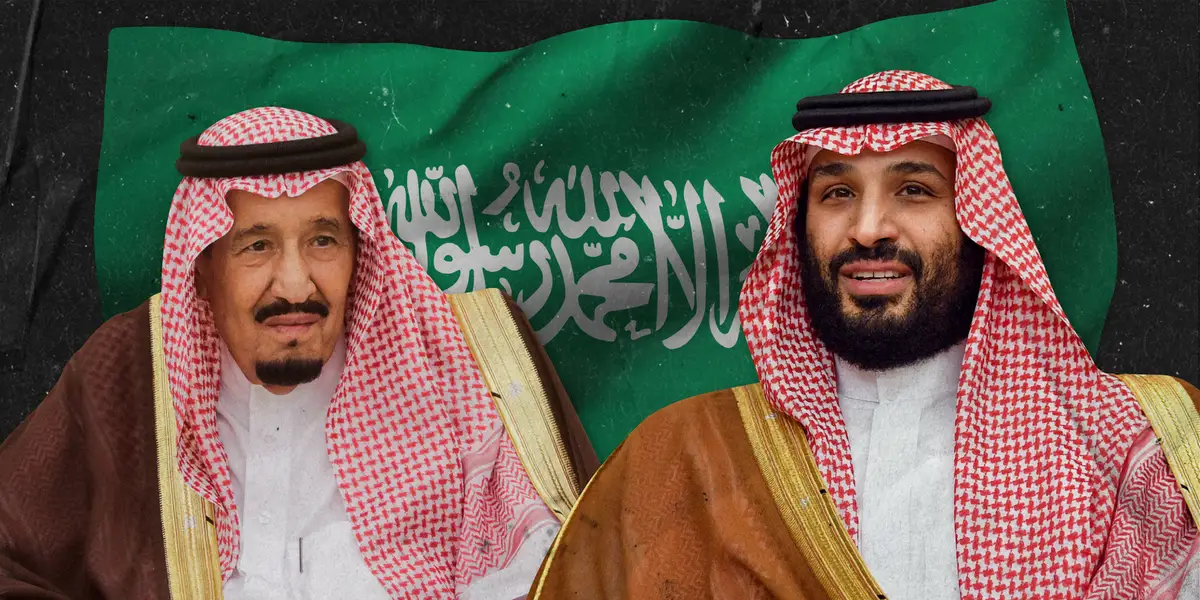
The recalibration of historical memory is inseparable from Crown Prince Mohammed bin Salman’s Vision 2030 agenda. The developmental vision seeks to diversify the economy, expand cultural industries, empower youth and women, and reposition Saudi Arabia as a global investment and tourism hub. And achieving this goal required major reforms at the social and cultural levels.
In the past, the 1744 storyline provided the religious elite (Ulema) and the religious police with immense justification to interfere in every affair of the Kingdom. To curtail this conservative religious grip (which he also tied to post-1979 extremism and radicalism in a lengthy 2022 interview with ‘The Atlantic’ magazine), Mohammed bin Salman has steered the state back toward its original “political and national foundations.” Through Founding Day, the current leadership is sending a message to the Saudi nationals that their identity is not the product of a Wahhabi religious militia called Al-Ikhwan or any other hardline religious ideologies, but is based on citizenship, the rule of law, and a social contract that exists between the state and the people. This day is a symbol of national unity, bringing all citizens together under one flag, transcending their regional, tribal, or sectarian differences.
Global Reach of the New Narrative and Harnessing Soft Power
The Saudi leadership is wielding this 300-year saga to amplify the Kingdom’s soft power worldwide. It assumes significance given how many detractors of the Gulf states, including Western media and policymakers, often sarcastically describe these states as “artificial creations from the lines drawn by Britain and France under the ‘Sykes-Picot Agreement’ after World War I” or as “countries built overnight by oil wealth.” Therefore, retracing the Kingdom’s history to 1727 is an attempt to demonstrate how it had taken shape, though nascently even before the United States (founded in 1776) and the French Revolution (1789), and that it possesses an indigenous, purely Arab grandeur history of state-building and survival through trials and tribulations. Before the current Saudi Kingdom took shape in the early 20th century, its earlier two iterations were the First State (1727 – 1818), which was brought to an end by Ottoman expansion in the region (through its Egyptian governorate led by Mohammad Ali Pasha), and the Second State (1824 – 1891), which collapsed due to internal strife.
This continuity and resilience prove that this state is not merely built on a few lines drawn on a map by Europe and abundant oil wealth, but on a strong national spirit, astute leadership, and resolute public support. In the realm of cultural diplomacy, Founding Day has transformed Saudi Arabia’s historical sites, particularly the ‘At-Turaif’ district in Diriyah (designated a UNESCO World Heritage site in 2010), into a global tourist hub. Mega-projects worth billions of dollars by the government, such as the “Diriyah Gate,” reflect that culture and heritage are now the new fuel for the Saudi economy and identity.
Significance in the Arab and Muslim Spheres
This evolving narrative also holds deep significance in the Arab and Muslim world. For a long time, the legitimacy of the Al Saud family’s leadership rested solely on its custodianship of the Two Holy Mosques (religious legitimacy) and on petrodollars (financial support for religious causes). Founding Day adds a new dimension to this, which can be termed “civilizational and historical legitimacy.” This is aimed at demonstrating to regional countries that the Kingdom is not a 20th-century post-World War I construct, but rather has a political structure with centuries-old roots that survived Ottoman dominance and Western colonial expansion in the region. It serves as a compelling argument that the foundations of the Saudi state are purely indigenous.
Simultaneously, this process of separating the state from ‘Wahhabism’ is being viewed as a positive development by the international community and among Muslims. This helps the Kingdom present itself as a modern and tolerant state, free from the stigma of extremism, that is leading its citizens toward art, culture, entertainment, and a bright future. Since Saudi Arabia holds the position of a leading centre of the Muslim Ummah globally, the impact of adopting flexibility, tolerance, and ‘Moderate Islam’ in its state narrative will inevitably influence other Muslim countries as well. It is expected that this intellectual shift will positively impact Muslim social and political attitudes worldwide.
Conclusion
Saudi Arabia’s celebration of Founding Day on 22 February is not merely a historical festivity, but an act of a nation rediscovering itself. It tells the story of a polity that endured fragmentation, survived external assault, revived after collapse, and now seeks to redefine itself for a post-oil century. By elevating 1727 as the foundational moment, the Kingdom underscores that its strength lies not only in its hydrocarbon wealth or religious symbolism but also in its political organisation, adaptive leadership, and historical continuity. As Vision 2030 reshapes the social and economic landscape, Founding Day provides the narrative scaffolding for transformation. The Kingdom presents itself as a state with deep roots in its soil and culture, yet with ambitions that reach far beyond them. In doing so, Saudi Arabia demonstrates a central truth of international politics: the future is often secured not only by reforming institutions, but by rewriting the story a nation talks about itself.