
Thomas De Quincey, the inaugurator of addiction literature in the West and an essayist of consummate variety, wrote an essay titled “On the Knocking at the Gate in Macbeth.” In it, he describes the moment when Macbeth becomes removed from the divine in the human (that is, love, understanding, etc.), and when the fiendish follies of human nature finally accrue to their soprano, turning the Scottish general into a murderer. De Quincey’s emphasis remains on the suspension of the good and the transition to the inhuman sphere that makes such an immoral act possible in the first place. His apprehension of the subject is profound and insightful, offering a glimpse into the inner mechanics of our senses as they are galvanized when experiencing great art. The notion of violence and darkness slowly rising toward its apotheosis has, since Shakespeare’s time, become ubiquitous, especially in popular media. Blasim’s stories thus upturn this narrative mode, which not only gives his fiction a fresh structure but also becomes a necessity for portraying the antagonistic environment inhabited by the Iraqi people.
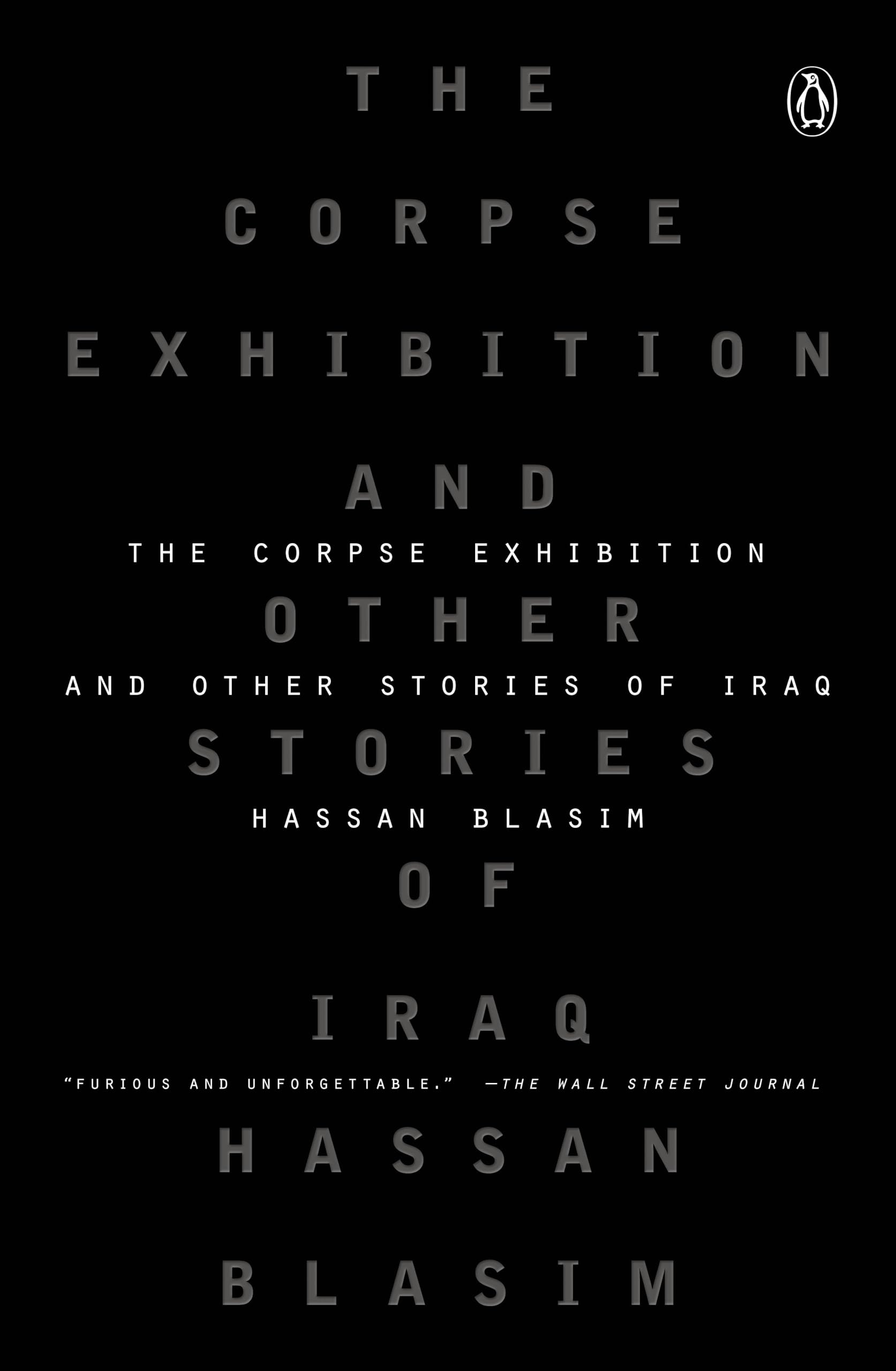
Compared to this creeping, shadowy transition to the dimension of the wretched and the immoral in Macbeth, Hassan Blasim’s stories in The Corpse Exhibition burst into the reader’s imagination. There is no transition from the human heart to the fiendish; rather, in Blasim’s stories, the human and the fiendish live in perpetual superposition. Worlds bleed into each other, and the divine and the defiled are no longer separated. The stories depict humans at their most pitiable: tortured, persecuted, destroyed, and, more painfully, still hoping at times. Set in Iraq during various periods over the past thirty-five years, Blasim combines horror, realism, history, fantasy, and violence to concoct a world of disgruntled brutality and incessant strife. Human agency is reduced to nothing; the characters in these stories are completely at the mercy of forces and actions beyond their comprehension and reach.
“But the children of the kingdom shall be cast out into outer darkness: there shall be weeping and gnashing of teeth”.
Gospel of Matthew
What makes these stories especially heartbreaking is Blasim’s depiction of the day-to-day ins and outs of Iraqi life in a space that has been completely devastated by war. Ordinary ways of living are corrupted by foreign interventions and sectarian politics. Childhood, Innocence, Security, Tradition, every aspect of life suffers innumerable violations. One is reminded here of Wittgenstein’s concept of “forms of life”: shared cultural practices, activities, and natural behaviours entrenched in the quotidian experience of existence that enable human beings to formulate meaning and understanding. In Blasim’s stories, these “forms of life” are entirely breached and uprooted. War appears as a tentacular entity no longer merely abstract but material, slowly infecting every part of Iraqi life and clasping its neck tightly.
It is therefore not shocking that many characters in stories such as “The Madman of Freedom Square,” “The Reality and the Record,” and “The Nightmares of Carlos Fuentes” descend completely into insanity by the end. Madness seems to be the only natural reaction in Blasim’s world. Hope, when it appears, is itself rife with another kind of violence—the violence of absence.
Magical realism plays an unusual role in Blasim’s stories, for it does not truly serve a conventional purpose. It neither pushes the plot forward nor redeems the characters. Instead, it stands for the ultimate meaninglessness that pervades his country. In the story “A Thousand and One Knives”, the characters can make knives disappear by shedding a single tear, yet no one in the story, until the end, understands where these knives go. The people in the story become friends because of this shared talent and wonder about their mutant-like ability. Unable to find any answers, Jaafar, the referee, wonders: “The knives were just a metaphor for all the terror, the killing, and the brutality in the country. It’s a realistic phenomenon that is unfamiliar, an extraordinary game that has no value, because it is hemmed in by definite laws”. Blasim makes the point explicit at several points in the book, as if he is speaking directly to the reader in a voice heavy with pain.
In the short story “The Iraqi Christ,” the titular character possesses the power to save others—a power he himself does not understand. Yet a character remarks midway through the story, “He thought his talent was just another sign of how impotent and insignificant we are in this.” As we read further, this direct dialogue with the reader reveals the writer’s humanistic side. Similarly, in “The Reality and the Record,” the protagonist speaks of a human obligation, divided into a poetic obligation and a human obligation. Blasim appears to place these two obligations in perfect harmony with one another.
In his work, the poetic blends homogeneously with the human. His fiction not only serves as a reminder of the consequences of war in Iraq but also gestures to its implications worldwide. Blasim’s work stands as a high point not only of Iraqi literature but also of world literature. His ability to combine elements from various genres—such as magical realism and philosophy—is deeply imaginative and simultaneously exposes the violation of the human condition in Iraq.
Blasim attacks everything that stands in the way of life. His work is not only an assault on the external forces that influence Iraq but also a violent condemnation of local hypocrisy, religious fundamentalism and the sectarian ideologies that have ruined his place of birth. Here is a writer whose heart bleeds as he writes, and the reader feels that blood as they move through the book. For Blasim, the absurdity of death reaches such an extreme that it becomes the only thing with meaning in a decrepit and meaningless world, where living itself is reduced to a triviality.
Thus, we must not merely groan or weep when we read Blasim’s work. We must stand in those doomed halls brocaded with black gold and witness the perpetual sense of loss that inhabits his world.