In the immediate aftermath of the Cold War, American political scientist Francis Fukuyama famously proclaimed the “End of History,” arguing that Western liberal democracy had emerged as the final and victorious model of political organisation. State socialism and authoritarianism, it was believed, had been decisively defeated by free-market capitalism and liberal democratic governance. In parallel, economist John Williamson articulated what came to be known as the “Washington Consensus”, which was a framework of global economic governance overseen by multilateral institutions and grounded in principles of fiscal discipline, privatisation, deregulation, and free trade.
The Washington Consensus rejected inward-looking state capitalism and championed the superiority of free markets and private entrepreneurship. However, its credibility suffered a major blow during the transatlantic financial crisis of 2008–09, misleadingly termed the Global Financial Crisis. Faced with systemic collapse, governments in the United States and Western Europe abandoned fiscal restraint and deployed massive stimulus packages to rescue private banks and industries. Ironically, the very states that had prescribed austerity and market discipline embraced large-scale state intervention.
China acted as a Keynesian intervention to revive the global economy. However, Beijing is heavily trade-dependent, with pre-crisis exports accounting for around 40 per cent of GDP. The significant downturn in global trade growth has affected China’s growth performance, but not in a major way. Consequently, China’s voice gained currency in the design of a post-Bretton Woods global structure. Since then, China’s model of development and economic engagements has been popularised as the Beijing Consensus, a term coined by Joshua Cooper Ramo in 2004. John Maynard Keynes’ long-forgotten theories suddenly gained popularity, showing that Keynesian concepts are not “in the long term we are all dead.” The efficacy of the international commercial network has also been called into question by protectionist trade policies, such as competitive currency devaluation and tariff and non-tariff obstacles. As a result, efforts are being made to review and revamp the World Trade Organisation.
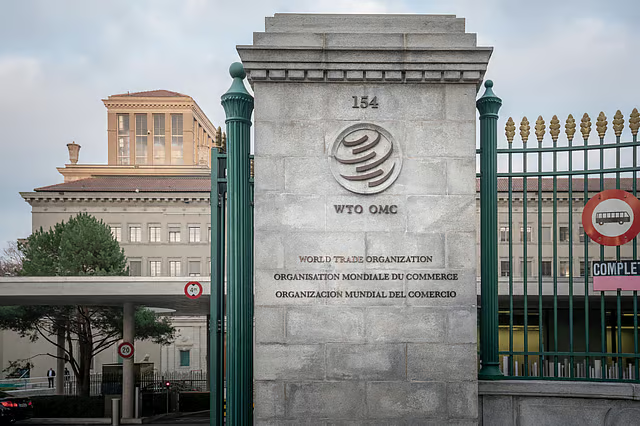
In this light, this article analyses the recent US proposal to reform the WTO to decipher whether the US follows the footprint of the Beijing Consensus and becomes another China. However, it does not support the prediction of WTO failure or irrelevance emanating from the Beijing Consensus and the US WTO Reform proposal. It only analyses the traction of similarities between the Beijing Consensus and the US WTO reform proposal.
The Beijing Consensus vs the Washington Consensus
Strong government intervention that may mobilise substantial resources to remove any obstacles to growth or institutional change is frequently credited with China’s impressive economic progress. In contrast to the Washington Consensus (WC), which is a model of neoliberal and market-oriented beliefs, this approach is frequently referred to as the Beijing Consensus (BC)- a model of authoritarianism and significant state intervention in the world economy.
According to the Beijing Consensus, institutional efficacy takes precedence over institutional purity. Institutions are crucial for economic progress, according to modern development economics literature. Furthermore, the 2025 Nobel Prize in Economics acknowledged that the invention was maintained by the interaction between prescriptive knowledge (how) and propositional knowledge (what and why), where the social efficiency test is required for institutional reform. Nobel Prize winners and the Beijing Consensus both support a thorough institutionalisation of the connection between these two types of knowledge to pass the social efficiency test. Only when institutions offer the proper incentives to balance the individual interests of economic and social actors with the interests of society as a whole can they be considered effective. It indicates that knowledge does not develop on its own. It is fostered by institutions and cultures and given legitimacy by concepts. Institutions’ epistemic cultures are deeply rooted in a scientific temperament.
In a world with a single, extremely powerful centre of gravity, it paves the way for nations to figure out not only how to develop but also how to fit into the international order in a way that allows them to be truly independent and safeguard their political choices and way of life. To increase locally entrenched advantages, it promotes a differentiated negotiation model. Furthermore, it is characterised by an increasingly deliberate collection of asymmetric power-projection instruments, a vigorous defence of national borders and interests, and a relentless desire to develop and experiment. It takes the place of the highly discredited Washington Consensus, an economic theory that gained notoriety in the 1990s for its prescriptive inquiry. The Washington-knows-best method of advising other countries on how to govern themselves lacks propositional inquiry into the specificity of nations.
Furthermore, the US’s rules of engagement, particularly the Washington Consensus, have been re-examined in light of the growing trade deficit, particularly with China. The US’s proposal for WTO reform reflects one of these factors.
US Proposal for WTO Reform
The Beijing Consensus promotes state capitalism over liberal capitalism. To improve WTO operations, the US proposal also justifies reciprocal tariffs and selective bilateralism. Moreover, the US has proposed three specific areas for WTO reform.
On decision-making, the US views plurilateral agreements—negotiations among willing members—as the only practical path forward for WTO rule-making. It contends that, given disparate economic systems and goals, reaching agreement among 166 members on more recent disciplines is impractical. The WTO’s continued relevance as a negotiating platform is said to depend on plurilateral agreements, which impose limited obligations and benefits on consenting parties. In the meantime, GATT Article XXIV already mentions regional and plurilateral agreements. The US government’s frustration with the consensus-based WTO, over which it has no control, is reflected in its emphasis on plurilateral agreements. The US appealed for plurilateral agreements among willing, like-minded nations, arguing that it is difficult to establish a consistent WTO model among all member nations. The Beijing Consensus, which supports a differentiated approach to negotiations with nations, implies the same thing.
Furthermore, it challenges the ongoing relevance of the Most Favoured Nation (MFN) principle, arguing that it was created for a period of economic convergence that has since passed. The US argues that, to maximise trade partnerships, nations must be free to treat trading partners differently due to growing economic policy divergence. It contends that by imposing one-size-fits-all solutions, MFN obstructs liberalisation that improves well-being. However, diluting the MFN principle would disproportionately hurt developing nations and strengthen power-based bargaining.
The US paper, however, does not address the prescriptive and propositional question of how the rights and interests of non-participants would be safeguarded or why WTO institutional resources should be employed for agreements in which not all members engage. The proposed plurilateral trade pact further weaponises commerce by alienating hostile nations while accommodating friendly ones in the absence of these corrective inquiries. Additionally, it raises legal and systemic issues about the potential for plurilaterals to be used for geopolitical purposes within a meticulously organised multilateral organisation.
On S&DT, the US takes a firm stance. It contends that, regardless of economic disparities, all other members should be subject to the same regulations and that flexibilities should be restricted to the least developed nations. Any deviation needs to be sufficiently justified. Therefore, by restricting S&DT to LDCs, the US hopes to shatter the unity of emerging and less developed nations and highlight the power imbalance between the global North and the global South. In its discussions with developing nations, it may utilise these LDCs as a hedge. Thus, the core of the Beijing Consensus and the US WTO reform plan is the idea of investigating and maintaining the asymmetry of power.
On a level playing field, non-market measures, according to the US, distort international commerce and erode confidence in the WTO, which promotes economic efficiency and trade liberalisation while ignoring the risks associated with reliance on concentrated supply sources. Issues like trade imbalances and overcapacity are linked to these practices. For investment and expansion, trade regulations must be stable and predictable. However, the Beijing Consensus is reflected in the US’s WTO reform recommendations, which mostly focus on institutional effectiveness—such as increasing transparency and compliance—rather than on promoting the general welfare of trading nations.
Any challenge to a member’s claim of vital security interests is rejected by the US. It maintains that WTO panels shouldn’t question such decisions because they are self-judging. This stance follows unfavourable decisions in cases contesting US steel and aluminium tariffs imposed on national security grounds. The list of goods covered by these protectionist measures has grown under the current Trump administration to include copper, lumber, cars, and auto parts, with more under consideration. As a result, the US WTO proposal suggests a state-mediated global trading system, similar to the Beijing Consensus, to encourage abnormal domestic tariff policies and currency manipulation by governments like China and, more recently, the US.
Conclusion
Trade deficits are important, but they shouldn’t be the only or primary factor influencing trade policy. Efficiency and empathy, with a sense of historical responsibility and the evolving present, must be the foundation of trade. Both the Beijing Consensus and the US WTO plan, however, compel liberal trade regimes to approve immediate state security inspections at the national government’s discretion, without redefining the WTO to account for the concentrated character of state-induced procedures that affect the organisation’s ability to operate. By endorsing the dilution of the MFN principle, selective plurilateral arrangements, limiting S&DT benefits to LDCs, thereby separating them from developing countries and maintaining the power imbalance between the global North and global South, and accepting states’ self-judging national security checks, the US’s WTO reform proposal is similar to the Beijing Consensus.