Antonio Gramsci’s reflection, “The old world is dying, and the new world struggles to be born: now is the time of monsters,” is often invoked to describe periods of transition. Donald Trump aligns with Gramsci’s prophecies, providing a useful lens to analyse the political moment associated with his presidency. A few decades later, the world will revisit the current order and be amused by analysing Donald Trump, a man of flesh and blood, becoming the most powerful man on earth. Trump is not just unique, but, without exception, the most ‘unconventional’ president in the history of the United States, both in style and substance.
His leadership has been marked by his war with everyone at home, against allies and institutions, as he shamelessly cosies up to his own charters of truth with malice. He has become a phenomenon that nobody knows how to reason with. His ostentatious attitude regarding the Nobel Peace Prize and his absurdly repeated claims of being a worthy contender are beyond laughter. This explains his madness. He mocks everyone, owns his absurdities as smartness, and punishes anyone who doesn’t accept his diktats. He has been an ambassador of false claims and, on the contrary, paints everything as fake that doesn’t accord with his whims.
In a recent interview with The New York Times, Trump appeared to express scepticism toward international law, particularly where it conflicted with his own understanding of national interest and morality. He said his decision-making was guided primarily by his personal judgment rather than by external legal or institutional constraints. He sets his morality as he wishes, not defined by any rule or law in the world. This might be the most egregious statement made by a serving president, as it represents a departure from the traditional emphasis that US presidents have placed on a rules-based international order and multilateral norms. The only group of leaders who seek his olive branch are those who either fear him or flatter his ego to gain his support.
The recent events in Venezuela are not just an assault on international law, but a horrendous practice that will not only endanger peace but might set an unusual precedent for the misuse of power against less powerful countries. He is threatening everyone and takes pride in using brute force against those who disagree with him—Venezuela, Greenland, and now Iran. Trump has made Xi Jinping, Vladimir Putin, or any other authoritarian leader anywhere in the world look decent. Trump’s statements regarding Taiwan, suggesting that China’s actions should be judged primarily through a transactional lens, have also raised concerns. Such reasoning could open a Pandora’s box, potentially legitimising expansive threat perceptions by major powers, thereby weakening existing norms around sovereignty and territorial integrity. If applied universally, this logic risks creating a permissive environment for revisionist actions by powerful states. How will Putin find his actions in Ukraine any different, or China against Taiwan, Bhutan, and anything they believe sacred to them as a civilisational strategy?
More broadly, Trump’s conduct reflects a deeply sceptical view of the post–Second World War international system. The silence in Moscow and Beijing over Trump’s absurdness will start a new world war. His repeated claims of grabbing Greenland are another façade that might be the end of the transatlantic order. His pronouncement of annexing Greenland personifies him as the settler coloniser in occupied East Jerusalem’s Sheikh Jarrah (Palestine), who openly chided a Palestinian woman to allow him to grab her house; otherwise, someone else would take it.
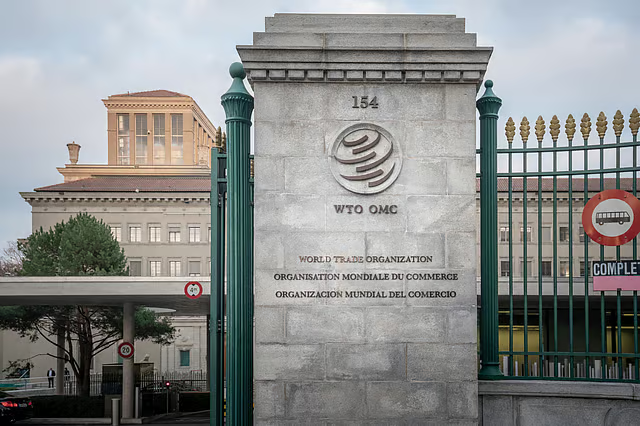
In Trump’s case, Greenland belongs to the US for all strategic purposes; otherwise, China or Russia might take it. It is inexplicable, as neither China nor Putin’s Russia has ever encountered such a contemptuous worldview. His foreign policy is a test for everyone to analyse, as it mocks any tool or theory that defines the most regressive aspects of foreign policy. His once-obsession with referring to Canada as the 51st US state was not just an infamous rambling. Foreign policy, defined as a strategy and a game of national interest, will inevitably have its own inherent inconveniences. No foreign policy undermines the concept of a sovereign order and international laws. That is the fundamental of the world order that Trump is hell-bent on destroying.
According to Trump, his own sensibilities, irrespective of how stupid they may appear, ought to be a qualified strategy and its ultimate goal. According to US law, Congress provides the framework for qualification, but it appears that Trump doesn’t care much about it. He is making America look preposterous compared to anything near greatness, which he fans as a common note in his statements.
Trump Grand Strategy: A charter of hogwash?
During his first presidency, he addressed the world at the United Nations, stating that the future belongs to nationalists and that globalists are fools. He fancies himself a political businessman, a self-proclaimed strategist who offers a unique solution to every challenge, one that transcends existing norms and regulations. His obsession with his worldview in the name of Make America Great Again will ultimately end US hegemony, if not its power. Power has a relative meaning, not just influence. It is also about how respectable and acceptable it is, not just bullying.
Hegemony extends beyond the influence of power; it is a system of thought and institutionalisation that creates a strategy for commanding trust, respect, and fear, if needed. It doesn’t require threat calls, as Trump does; rather, it is an indispensable player without whom the system can’t function. US foreign policy since the Second World War has been shaped and formulated by the deep state. It is the CIA that sets the rules, and the presidents follow them, barring a few exceptions, such as US intervention in the Israel–Palestine context during George Bush Senior or Carter, or not favouring the punishment of Iran during the post-1979 hostage crisis. There might be similar instances, but overwhelmingly, it is the deep state.
Trump owns both. He himself has been behaving like a deep-state strategist (who once announced that he would throw it out) and also as the powerful president who only knows how to hear “yes” and be the protagonist of the whole story. His fatuous claims of stopping all wars, including brief military confrontations between India and Pakistan, sound more hilarious than any stand-up comedian. His runaway claims that he “settled 8 wars… Some of them, which were just getting ready to start, like India and Pakistan, where already 8 jets were shot down… I got it done in rapid order, without nuclear weapons. I can’t think of anybody in history who should get the Nobel Peace Prize other than me.” He did not stop himself from braving his claims for a deserving Nobel Prize, but challenged President Obama’s 2009 Nobel Peace Prize.
At present, he may be instrumental in bringing billions of dollars to the US economy, but ultimately, he is driving the final nail into the coffin: the collapse of US hegemony. Whether it will be better for the world or worse is uncertain.
Any Method of Madness?
It is beyond reason to explain his method of madness. Bob Woodward (the acclaimed journalist who has been instrumental in revealing how US presidents think), President Obama, and many members of the US Congress have declared him unfit to be in the White House. Interestingly, in 2017, a group of mental health experts in the US published a book on his mental status, “The Dangerous Case of Donald Trump: 27 Psychiatrists and Mental Health Experts,” edited by forensic psychiatrist Bandy X. Lee, which declared Trump’s mental state a “clear and present danger” to the nation.
His idiosyncrasies are evident in his twice-impeached status as the only US president to face such a fate. There has been a clarion call within the US for his removal due to his perceived unworthiness to be president. The challenge, however, has been legal provisions. The US president can be removed either through impeachment or through Senate support (a two-thirds majority), with the further limitation of Section 4 of the Twenty-Fifth Amendment (which can only apply if the president fails to discharge his duty). In 2021, 57 of the 100 senators voted to convict Trump —10 short of the 67 votes required. However, since Republicans held the majority, his impeachment through the Senate failed. He has been categorised by many, but is still holding his position as a systematic failure.
Is there any silver lining?
Trump’s dangerous worldview will definitely change the world in the manner he governs. The only trouble is that the darkness will loom large. He is arming and weaponising lawbreakers, amoral politicians, and populists all over the world. This threatens the very idea of sovereignty and international law, which need to be strengthened to survive, rather than crippled for one’s own ego trip.
Trump calls himself the saviour who will make America great again. The only difference between him and any unreformed person or criminal is that his power can affect and alter the lives of millions, and that is dangerous. He doesn’t mind invoking God as his saviour. He refers to his actions as messianic. His narcissism has made adversaries and allies equally nervous. The unipolar world is certainly in decline, and a multipolar world has yet to emerge as a viable alternative to the American-led world order. In such a scenario, how will the world look back on his legacy? This is definitely the time of the monster. Trump will go down in history as the man who changed the world—not as a thinker, but as a ‘monster’.
Disclaimer:
The views and opinions expressed in this article are solely those of the author and do not necessarily reflect the views, positions, or editorial stance of Middle East Outlook (MEO).