“There lies a sleeping giant. Let him sleep! For when he wakes, he will shake the world.”
This quote, often attributed to Napoleon Bonaparte, has been closely linked to China’s aspirations to shape the world order over the centuries. It resonated when Mao Zedong led the establishment of the People’s Republic of China in 1949, based on communist principles and a socialist economic model, to transform it into a credible global actor while reclaiming its “glorious past”. Yet it was the gradual reorientation of its economic policy under Deng Xiaoping, Mao’s successor, which placed it on the path of development seen today. Under Xiaoping, Beijing substituted its socialist economic model with State Capitalism even as it strictly enforced its communism in the socio-political sphere, as was evidenced by the suppression of student protests at Tiananmen Square in 1989.
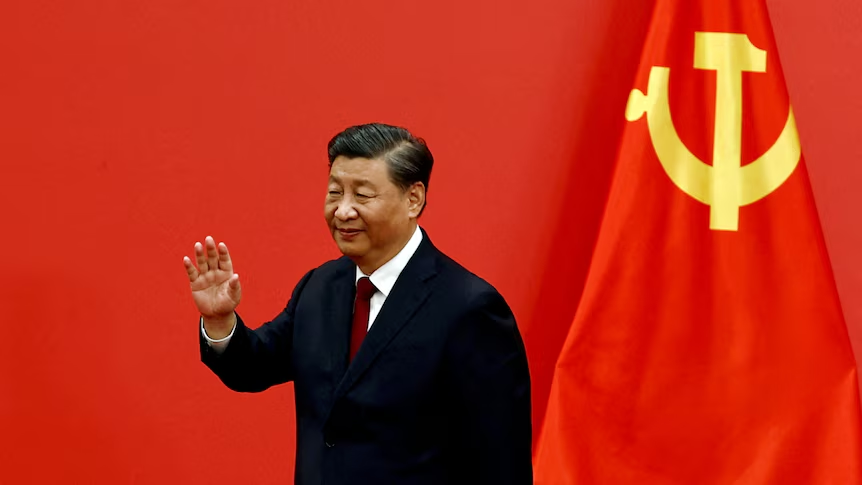
While this redirection pushed China to become the ‘factory of the world’ as its economy expanded exponentially, its global profile witnessed a major turnaround in the late 2000s. This coincided with the rise of Xi Jinping, both within the ranks of the Communist Party of China (CPC) and the government. After he took over as president of China and chairman of the CPC in 2013, there has been a fundamental shift in Beijing’s outlook towards global affairs. Under Jinping’s command, China has emerged as a global power in its own right and a credible challenger to the supremacy of the United States. This dynamic has been acknowledged by US President Donald Trump, who proclaimed his recent meeting with President Xi Jinping as a G-2 (group of two) meeting.
But this rise also meant heightened tensions with Washington, which has been described by many as Cold War 2.0. Moreover, an assertive China with increased diplomatic and political heft has also seen an increase in border disputes within the neighbourhood, an intense crackdown on protests and dissent against the government internally, as well as growing militarisation and nuclearisation.
One of the most significant projects that showcases China’s global reach is President Xi Jinping’s 2013 unveiling of the One Road, One Belt Road (OBOR), subsequently known as the Belt and Road Initiative (BRI). Also known as the New Silk Road, this initiative aims to replicate the global trading centrality of China achieved during the Han dynasty era through the Old Silk Route. Initially, it sought to connect the country to Europe via the Central Asian Steppes, but it has since been gradually expanded to encompass Oceania, Latin America, and Africa.
On the face of it, the BRI was projected as a mere economic project aimed at ushering development through mutual cooperation between Beijing and its partners. As President Jinping stated during his 2019 keynote address at the Beijing Belt and Road forum, this “cooperation embraces the historic trend of economic globalisation, responds to the call for improving global governance system and addresses people’s desire for a better life.”
The BRI was launched with multiple objectives, foremost to expand Beijing’s geoeconomic influence, including strengthening its mineral supply chain to feed its gigantic manufacturing base and market access for its exports. As China extended its economic largesse to underdeveloped countries across Asia, Africa and Latin America, many Chinese likened the BRI to the American Marshall Plan for Western Europe. Beijing has envisioned spending $4 trillion on this project, with $ 1.38 trillion already allocated, aiming to reach two-thirds of the world’s population and account for a third of the world’s GDP.
At the same time, many have argued that the BRI was inherently a strategic project of China aimed at reshaping the US-led, Western-dominated global order to its own advantage. Many even argued that the “supposed” global retreat of Washington, particularly under President Trump, as evidenced by his withdrawal from the Trans-Pacific Partnership and Afghanistan, has allowed China a free hand to increase its strategic influence across the continents. Yet, such assumptions are fallacious and, at best, naïve, given that Beijing has shown reluctance to engage at a broader political level with issues of global concern, which may stem from a lack of international popular legitimacy relatively to the US.
The US’s global empire rests on three elements of power: military might, the largest global economy, and unmatched intellectual power (soft power). The American structure of global alliances and partnerships rests upon the legitimacy it has within the international community, which in turn has been a product of American intellectual prowess. China still has a long way to go to cultivate such kind of soft power credentials.
China’s transformation from a communist state to one of the leading examples of state capitalism has been nothing short of phenomenal, particularly its emergence as a credible challenger to the United States on multiple fronts over the years. Yet, Beijing still faces some obstacles in navigating the international geopolitical landscape, as it has yet to achieve the same degree of global popular legitimacy as the US. As such, while the sleeping giant may have surely awakened, it will take another great leap forward.