How the rhetoric of religious nationalism travels from the campaign rallies of Bihar to the Christian pulpits of America.

America — The Polite Face of Majoritarianism
At a recent Turning Point event in Mississippi, US Vice President J.D. Vance was confronted with a question by a young woman of Indian origin, which reflected a frustration common among immigrants who were once promised inclusion but now find themselves defending their place in America’s broader sociopolitical landscape.
“You are married to a woman who is not Christian,” she noted. “How are you teaching your children not to place your religion above their mother’s? And why is Christianity still seen as the measure of loyalty — as if being Christian makes you more American?”
Vance’s response was carefully calculated. He explained that his wife, Usha Vance, “grew up in a Hindu family but not a particularly religious one,” that both were agnostic when they met, and that he had since embraced Christianity. Their children, he confirmed, were being raised Christian, with their eldest having recently received his first communion, and they attend a Christian school.
This was followed by a controversial remark:
“Do I hope eventually that she is somehow moved by the same thing that I was moved by? Yeah, I honestly do wish that. Because I believe in the Christian gospel, and I hope eventually my wife comes to see it the same way. But if she doesn’t, God says everybody has free will — and that doesn’t cause a problem for me.”
Vance’s response was not an explicit call for conversion, nor an act of hostility. Rather, it was what political theorist Michael Billig calls banal nationalism, wherein subtle signals establish what counts as “norm” and “exception.” It not only reflected the personal dynamics of faith in his family but also implied that the ideal American is Christian by culture, instinct, and civic identity. Although others are tolerated, they are exceptions to the norm. This is a subtle display of soft majoritarianism where dominance is asserted not through law, but through narrative.
The Quick Rebuttal and the Diaspora’s Double Bind
The advocacy group, the Hindu American Foundation (HAF), publicly criticised Vance’s remarks, urging him to “engage with Hinduism too” and reminding him that plurality requires reciprocity, not condescension. But this reprimanding response also laid bare the irony of diaspora politics. Hindu Americans demand equal recognition of their religious identity with their dignity intact in the US and globally, while supporting a project back home that feeds on marginalising religious minorities, particularly Muslims and Christians. They seek religious freedom abroad while endorsing religious hierarchy at home.
To put it straight, Hindu Americans’ vehement support and aid to a certain political cause in India that thrives on majoritarian and religious-nationalistic narratives while seeking the freedom to practice their religion in the United States without fear of stigma seems to be falling apart.
Sociologist Rogers Brubaker explains, nationalism today operates transnationally, with beliefs migrating, changing, and reflecting one another rather than remaining confined within national boundaries, thereby creating a transnational moral field of nationalism. Diasporic communities often find themselves in a precarious position; they can oppose majoritarianism in both their home and host countries, but they frequently replicate one to protect themselves from the other.
India — The Rhetoric of Infiltration and the Demography of Fear
While Vance spoke of immigration threatening “social trust” and maintaining a “common community,” India’s ruling leadership advanced the same argument through the language of protecting “Hindu civilisation.” In both situations, the same fear that diversity undermines a sense of belonging is hidden by the language of safety and togetherness.
Take the recent electoral campaign of the ruling Bharatiya Janata Party (BJP) in Bihar. Its senior leader and Union Home Minister Amit Shah, while speaking at the Dainik Jagran lecture series in Patna, claimed that India’s “rising” Muslim population was “not because of fertility rate, but because of large-scale infiltration from neighboring countries” like Bangladesh. He called for a policy to “detect, delete, and deport” such “foreigners” from the country’s official electoral records.
A few days later, Prime Minister Narendra Modi echoed the message, warning that “vote-bank politics” and “infiltrators” endangered both Bihar’s social order and India’s borders. Although the language of security and sovereignty was used, their underlying message was clearly communal, turning citizenship into a litmus test of faith.
The argument mirrors Vance’s “social trust” proposition in Hindutva form. Both Modi and Vance mention a mythical society whose purity must be protected from outsiders when they propagate how too many immigrants undermine social cohesiveness and how Bangladeshi or Rohingya “infiltrators” were altering India’s demographics. The logic remains the same: belonging is conditional as demographics determine identity, and citizenship is tested through faith.
From Borders to Bodies
These ideas remind us of what Judith Butler termed the politics of precarity, where certain lives are made more vulnerable simply because the state names them differently. In India, this vulnerability manifests in laws like the Citizenship Amendment Act (2019), which fast-tracks citizenship for non-Muslim refugees from neighbouring countries. In the US, it appears in the moral hierarchy that treats non-Christians as civic guests rather than equal citizens.
The intensity differs, but the emotional grammar is identical. Both political ideologies depict foreigners — immigrants, minorities, and dissenters — as a matter of numbers, religion, and loyalty entangled in an “Us vs Them” rhetoric.
The Transnational Mirror
Political scientist Kanchan Chandra describes this as majoritarianism without majorities — a politics that manufactures a homogenous people by excluding parts of itself. While in the BJP’s and the broader Hindutva political discourse, Muslims become the demographic threat that produces Hindu unity, in the Christian civic core, it is the immigrants who become the cultural threat that supposedly creates anxieties.
The irony is again seen in the diaspora loop. Many Indian origin Americans celebrated the inauguration of the Ayodhya Ram Temple earlier this year, organising events from New Jersey to Silicon Valley. However, these same groups are now subjected to the polite condescension of American Christian nationalism, with even the country’s vice president referring to his Hindu spouse as spiritually inept.
The diaspora loop is vicious. Hindutva exports its politics through the diaspora; Christian nationalism mirrors it back through moral hierarchy. Each validates the other’s belief which turns diversity into a management project to be managed and not embraced.
The Diaspora: Messenger and Mirror
Diasporas are now recognised as influential non-state actors, capable of exercising influence on both domestic and foreign policy. Political scientists Prasad and Savatic (2021) refer to diasporas in this context as foreign policy interest groups that utilise cultural capital, lobbying, and resources to shape the understanding of their countries of origin. Similarly, Loshkariov (2023) refers to this development as long-distance nationalism, which involves the expansion of domestic ideological struggles across international borders through rhetoric, ritual, and donations.
The Indian-Hindu diaspora in the United States serves as one of the most prominent examples of this dualism. A significant section of the diaspora has mobilised to support religious institutions, circulate positive narratives, and commemorate important events such as the consecration of the Ram Mandir this past year. Discussions of pride regarding Hindu-ness and reclaiming the nation occur in suburban temples and through WhatsApp groups outside of India, making distance irrelevant.
Cross-Border Echoes of Exclusion
When a prominent American politician, such as Vice President Vance, terms his wife’s Hindu heritage as something spiritually incomplete or when Christian nationalism represents the idea of public morality, Hindu Americans come to experience what it’s like to live as Indian Muslims under the dominant Hindutva discourse. The diaspora finds itself at the crossroads of an ardent desire for pluralism abroad and majoritarianism at home.
Both of these cases are typical examples of ‘the fear of dilution’. Vance fears that a dramatically higher number of immigrants will “destroy social trust” and keep America from becoming a “common community.” Modi and Shah warn that “infiltrators” from the Rohingya communities or Bangladesh will change India’s demographics. Anthropologist Veena Das describes these situations as “communities of anxiety,” or civilisations bound together by distrust rather than hope.
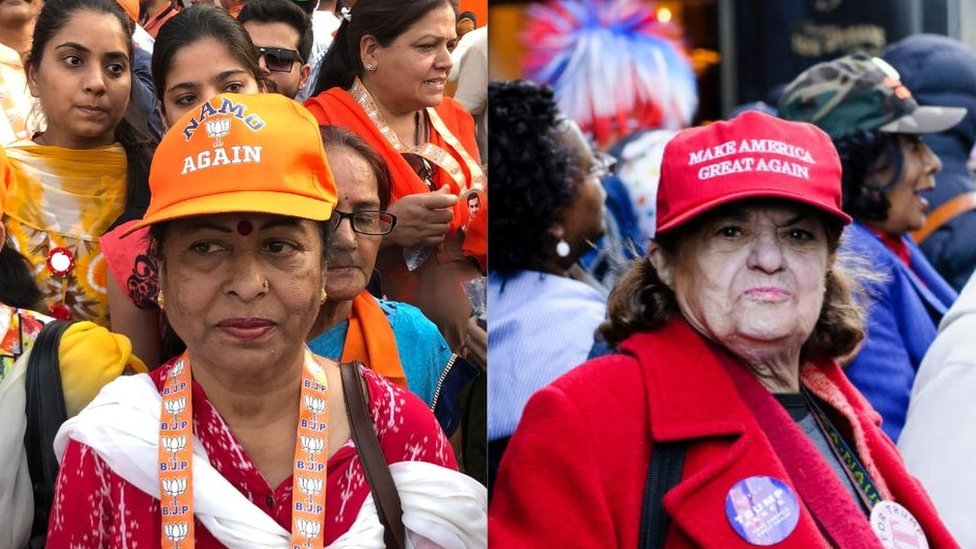
Such fears thrive because they are consistently reproduced through images and performance. Chants and saffron scarves, common at Bihar’s rallies, or the cross and flags in American campaign halls encourage citizens to regard themselves as defenders of a faith-civilisation and not as members of a plural and democratic society. Therefore, what begins as a matter of personal beliefs turns into statecraft that damages both democracies. For the Indian-Hindu diaspora to demand temple bells abroad while maintaining silence about mosque loudspeakers being removed at home is a downright hypocritical act.
Philosophically, we can understand it through Judith Butler’s concept of precarity. It reminds us that security based on someone else’s exclusion is never true security; it is an illusion fed by fear. If one pays close attention, the language in Patna and Washington resonates. The Hindu American who feels threatened at a Christian politician’s subtle condescension, or the Indian Muslim who is constantly challenged to prove patriotism, experience the same sense of alienation in a place that claims to be inclusive, free, democratic and secular.
Conclusion: The Mirror of Majoritarianism
Thanks to algorithms, fundraising platforms, and live election campaigns that span continents, religious nationalism is an easy export. The Hindutva claim that India must reclaim its Hindu heritage at its core, and the Christian-nationalist idea that America must be Christian in spirit are parallel campaigns of moral cleansing disguised as patriotism.
If Hindus overseas endure the subtle exclusion of Christian nationalism, while Muslims in India face the outright declaration of Hindu nationalism, history may be giving a moral reckoning. Freedom of religion cannot be demanded without reciprocation. The same plurality and acceptance that the diaspora advocates overseas must be defended, rather than suppressed, at home.