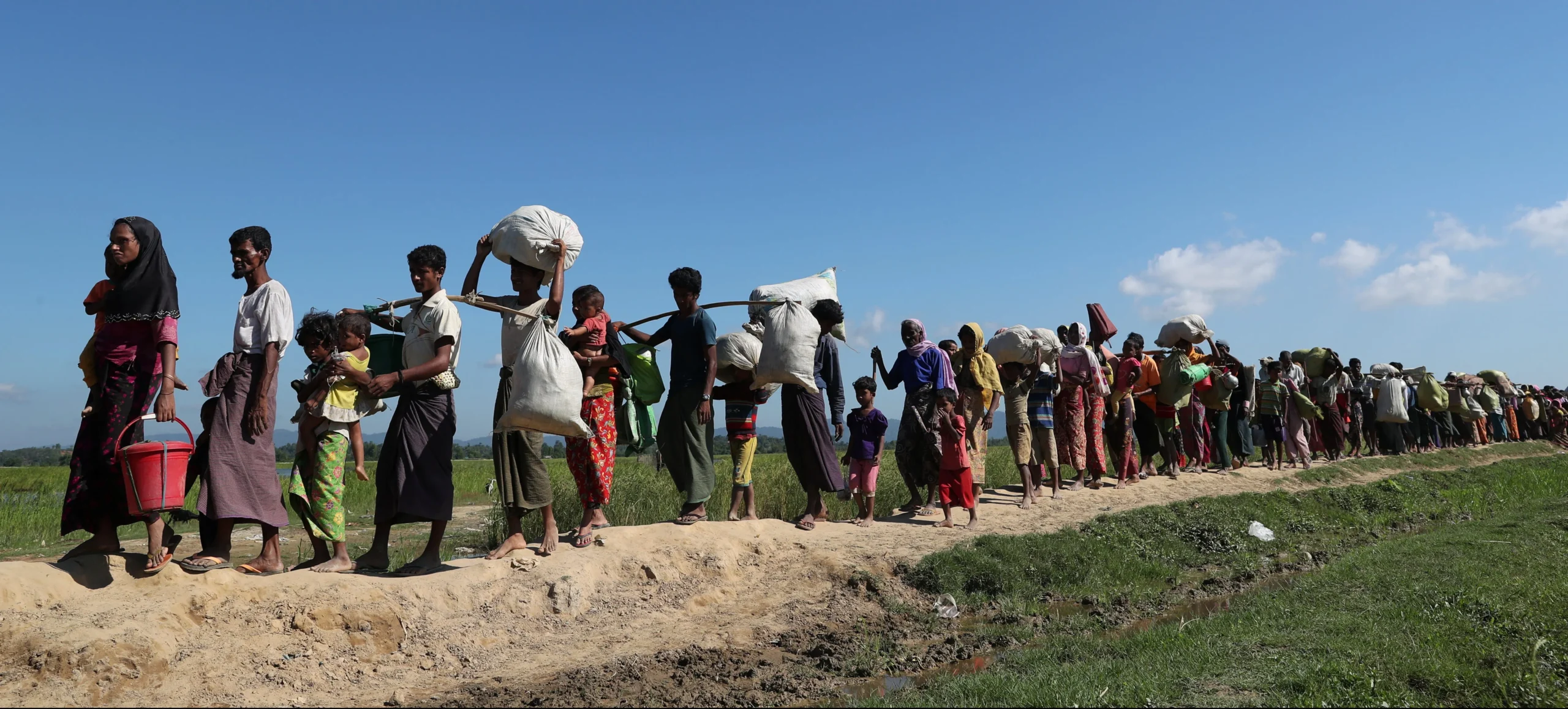

It has been over eight years since the skies over Rakhine state in Myanmar were lit with the smouldering fires of Rohingya Muslim villages, as the military razed hundreds of settlements, sexually assaulted women, and forced hundreds of thousands to flee their homeland, dangerously crossing the Naf River into Bangladesh in dinghies. All this happened while the international community either watched in silence or, worse, with acquiescence, in what the United Nations would later describe as a “textbook example of ethnic cleansing.” Nearly a decade later, the fate of Rohingya Muslims remains unchanged, with over a million live crowded in the world’s largest refugee camp at Kutupalong, Cox’s Bazar, Bangladesh, without land, state, or future.
Ever since their forced displacement through an ‘ethnic cleansing’ pogrom by the Myanmar Army, Rohingya Muslims observe August 25 as “Genocide Remembrance Day,” to bring attention to the torture, killings, sexual violence and arson they endured, with the hope of breaking the silence of the international community. Yet, as the calendar turns month after month and year after year, their hopes of repatriation fade into a distant dream, fearing being consigned to be forever refugees with no prospect of return ever. Forget about taking back a single refugee — Myanmar’s Military Junta continues to persecute the community. While the world moves on to newer wars and more photogenic victims, Bangladesh, once lauded for opening its borders to offer succour, stands almost alone in tending to this crisis.
However, the broken regional polity, half-hearted international responses, and the growing frustration in Bangladesh over the global community’s indifference makes one wonder to ask whether Rohingya lives matter at all to the international community, the way Ukrainians do, for instance? Moreover, the stark truth is that without accountability in Myanmar, the prospect of resolution of the Rohingya crisis and any hope of their return to Rakhine is nothing but an illusion.
Rather than diminishing, the tragedy worsens, and so do any hopes of repatriation. Increasing numbers of Rohingya are still forced to cross into Bangladesh to escape unending violence, now not only from the state but also from the separatist Arakan Army, which has clashed with the Military Junta over control of Rakhine state. Most of those fleeing are forced to do so during nights, risking drowning or worse capture. And the result is that Cox’s Bazar’s Kutubalong camp continues to grow crowded, not only leading to frustration among locals but also stretching the capacity of the Bangladesh government, amidst economic stagnation of the last many years.
Since 2017, the global dynamics have shifted dramatically. The Middle East is convulsed by fresh conflicts. Europe worries about migration at its borders. South Asia has seen the political churn with the ouster of regimes in Sri Lanka (2022), Bangladesh (2024), and now Nepal (2025). And more importantly, the Russia-Ukraine war (since 2022), and Israeli aggression on the besieged Palestinian territory of Gaza (since 2023), and other Middle Eastern countries like Lebanon, Syria and Iran, have dominated headlines since. In this turbulence, the Rohingya issue has been gradually pushed to the footnotes of the discourse.
More so, despite UN Secretary-General António Guterres’ recent visit to Cox’s Bazar to emphasise the urgency of the crisis, this has not translated into any tangible shift in global discourse or significant aid increase to meet basic refugee needs. Although Malaysia floated a “peace mission” to Myanmar at the regional level, its ability to influence the Military Junta or the Arakan Army to permit safe, dignified returns remains a foregone conclusion.
For Dhaka, the Rohingya crisis is no longer just humanitarian, but it has grown complex with economic, social, and political dimensions of its own. Hosting nearly one million refugees while Bangladesh grapples with its own politico-economic instability has turned the situation contentious. This makes the current arrangement increasingly untenable in the long run. At the local level, for instance, when Rohingya Muslims first started arriving in August 2017, people in Cox’s Bazar initially welcomed them with food and shelter, assuming, like many others, that the crisis would be temporary.
Bangladesh provided Myanmar with lists of over 800,000 Rohingya eligible for repatriation in six phases from 2018 to 2020. Even in April 2025, Myanmar’s junta foreign minister promised to accept 180,000 refugees during a BIMSTEC summit in Bangkok. But that plan never materialised as the Arakan Army outrightly rejected it. Therefore, instead of any signs of their repatriation, Rohingyas continue to arrive even after eight years, making many locals now to perceive them as a drain on resources and a source of insecurity.
At a commemorative event in Cox’s Bazar this August, Yunus laid out a seven-point roadmap to solve the Rohingya crisis. It included the right of return, sustained aid, an end to violence, dialogue, regional involvement, opposition to ethnic cleansing, and accountability. While these propositions may seem noble, they do not add up to anything without any enforcement. And the pressing question is, who will make this possible?
Moreover, a decade-long limbo is also leading to radicalisation of some sections of the refugee population. There have been reports of armed groups operating within the refugee camps, which have not only clashed with each other but at times with the Bangladeshi security forces as well. As such, for Dhaka, the longer repatriation stalls, the greater the risk of militancy, human trafficking, and regional destabilisation. Bangladesh’s Foreign Affairs Adviser, Md Touhid Hossain, recently warned at the United Nations that “this is not just Bangladesh’s problem anymore,” as it risks not only destabilising South Asia but a potential spillover into Southeast Asia.
Rohingya Muslims often ask why their suffering does not command the same urgency as that of Ukraine or Gaza. For instance, just this month, European leaders met with Donald Trump in Washington to reaffirm support for Kyiv. Streets in Europe swell with protests against Israel’s bombing of Gaza. Yet, voices for the Rohingya fade into silence. While the UN Human Rights Office continues to describe Myanmar’s actions as ethnic cleansing, the follow-up from the international community is merely rhetorical. Though there are sanctions against the junta regime, these have proved ineffective in forcing Myanmar’s government into compliance and stopping the forced displacement of Rohingya Muslims.
At the regional level as well, as Bangladesh often complains, countries like China and India have often overlooked the ethnic cleansing of the Rohingyas. Worse, Beijing has been accused of providing a diplomatic shield to Myanmar’s military junta. While China has geoeconomic interests with Myanmar’s military regime, India remains wary of pushing Naypyidaw into Beijing’s full embrace and undermining its security collaboration to maintain peace along the border in its northeastern region. Though both of these countries claim to “support repatriation” of Rohingyas to Rakhine state, they have refrained from pushing the military junta to undertake any steps towards resolving the issue.
Meanwhile, armed groups in Rakhine worsen the situation. The Arakan Army, which demands autonomy for Rakhine state and was once seen as a possible alternative to the central government, now mirrors the violence of the Military Junta in its treatment of Rohingyas, especially after their ceasefire collapsed. Some Rohingya have ironically found themselves fighting on opposing sides of Myanmar’s conflict, becoming cannon fodder in desperate attempts to survive.
On the eighth anniversary of the ethnic cleansing of the Rohingyas, various diplomatic missions in Dhaka, including the UK and the US, issued statements of solidarity. Many praised the generosity of Bangladesh’s government and people, promised humanitarian aid, and decried the continued violence against Rohingya Muslims by both Myanmar’s military and the Arakan Army. But for the stateless, voiceless, and exiled refugees, these statements of condemnation and promises ring hollow as no amount of sympathy is going to change their fate unless the international community matches their words with tangible actions.
History reminds us that peace built on selective empathy is no peace at all. The plight of Rohingya Muslims is not a “local issue,” but a test of the global community’s conscience. As long as children in Cox’s Bazar grow up behind bamboo fences, the promise of universal human rights remains broken.
The only question left is whether the decade-long suffering of the Rohingyas will be enough to compel the international community to act in their favour, helping them reclaim their lives and homeland with dignity — or whether they will remain forever relegated to the footnotes of history.