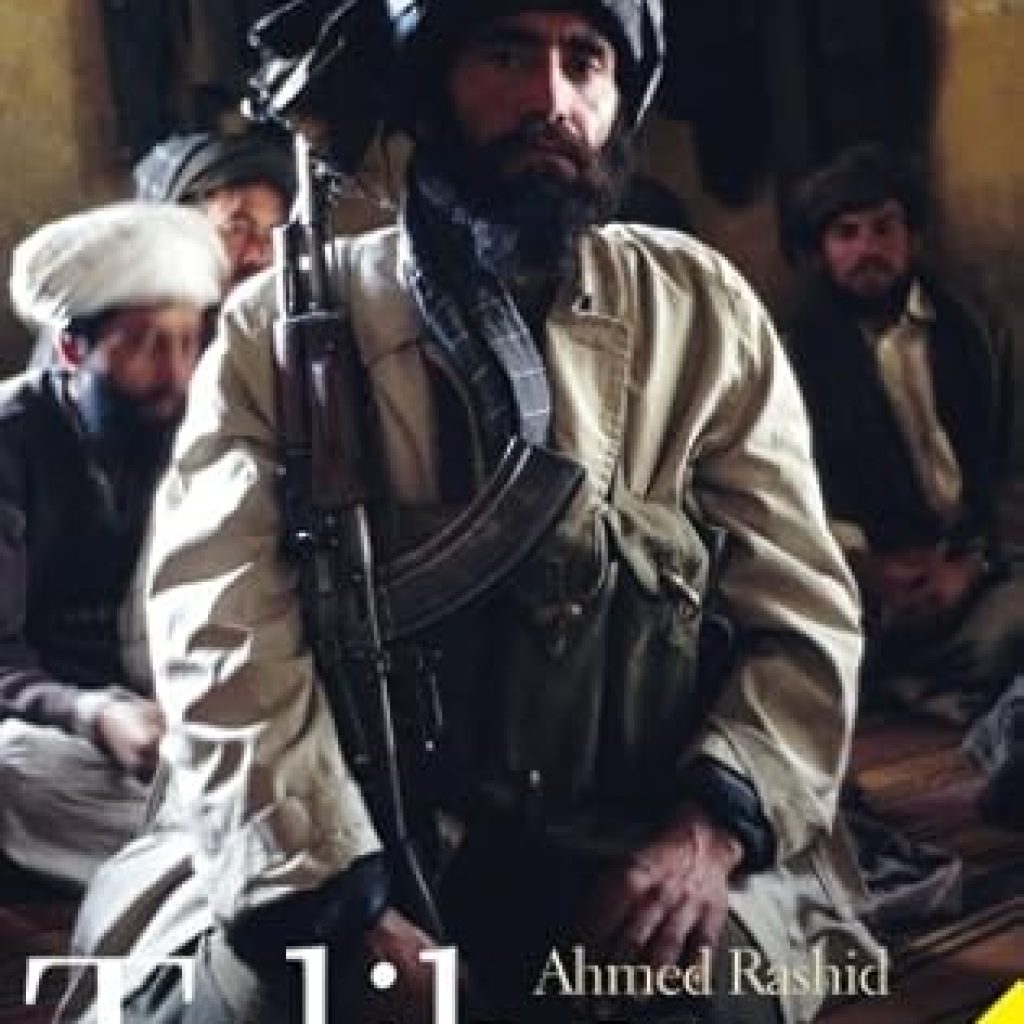
As the United States withdrew its troops from Afghanistan in 2021 after two decades of fighting the Afghan Taliban following the 2001 invasion, it ironically enabled the same Islamist group to regain control of the country. The Taliban has since doubled down on re-implementing its ideological project in the country. The endurance of this group, not only sustaining a full-scale insurgency for two decades against arguably the world’s strongest military and a NATO-led multinational coalition, but also reemerging as ‘victorious’, provokes curiosity about the ideological precepts that underpin it. In this context, Pakistani journalist Ahmed Rashid’s Taliban: Militant Islam, Oil and Fundamentalism in Central Asia offers one of the most comprehensive explanations of the origins and rise of this group. Although this book was published in 2010, it continues to be one of the most authoritative accounts of the movement.
The author organizes the book in three major sections, deconstructing the Taliban’s origins and ascent, ideological and social foundations, and role in regional geopolitics in what Rashid terms the “New Great Game”. This clear structure allows readers to trace how a localized militia transformed into a regional power with global significance, from a group of armed students under Mullah Omar to a powerful extremist group. The narrative then moves through the influence of the Taliban, from the Islamic faction of ‘Deobandism’ to creating a stricter interpretation of Islamic laws, while also touching upon the structural and political settings of the Taliban regime. Finally, Rashid discusses how international rivalries have deepened the conflict in Afghanistan, focusing on the strategic contest between the US and Russia, engaged in a battle of wills over pipeline competition in Central Asia.
The book opens with a historical overview of Afghanistan, highlighting its rule by the Persian, Indian, and Mongol conquerors. The demise of King Zahir Shah marked the end of crown rule, and Afghanistan was declared a republic under Daud Khan, who was backed by the Soviet Union’s communist policies (p. 9-11). Building on this backdrop, Rashid examines the Soviet invasion of Afghanistan within the broader context of Cold War rivalry between the United States and the Soviet Union and the emergence of the Mujahideen, which significantly influenced the Taliban’s emergence in the already war-torn country (p. 13).
Rashid then details how mujahideen emerged to establish the Taliban in Kandahar in 1994 with the support of Pakistan, which acted as a preeminent patron of anti-Soviet Afghan fighters during the Afghan jihad. The book demonstrates how Pakistan’s Inter-Services Intelligence (ISI) leveraged Islamic seminaries (madrasas) and tribal networks in Afghanistan to help recruit fighters for the Taliban, even though the group portrayed itself as an independent Islamic force (p. 23-30). For Pakistan, installing the Taliban in Kabul meant nurturing strategic depth to keep its regional adversaries like India at a distance. With this support, the Taliban quickly expanded its control of Afghanistan, starting with the capture of Herat in 1995 and Kabul in 1996. Rashid connects these victories to the collapse of the Soviet-backed Najibullah government in 1992, which left a political vacuum, thus spawning competing factions among Pashtuns, Tajiks, Uzbeks, and Hazaras, whose rivalries further fragmented the country.
The book narrates these campaigns vividly, though without exploring the role of the international forces that enabled them. Instead, the author stresses that the Taliban’s momentum was more about the strategic weakness of their opponents. Rashid highlights how the Taliban grounded its authority in a distorted form of Deobandism, adopting an extremist ideology, advocating Islamic revolution, rejecting modernism and an interpretation of Shari’a pleasing to their ideas (p. 87-92).
The book then highlights how the Taliban controlled social life by policing the lives of people in all aspects, besides closing the doors of schools for women, banning cultural expressions, thereby confining women to homes without education or employment, effectively erasing them from public life. Alongside this repression, the Taliban sustained themselves through the opium trade and by hosting foreign militants such as Osama Bin Laden, tying their rule to both illicit economies and global jihad. Rashid’s account richly documents these features, but his focus is largely descriptive. He details what the Taliban did without fully interrogating how their claims departed from the broader Islamic traditions or why Afghan society proved so vulnerable to their rule.
Part three shifts focus to geopolitics, where Rashid situates Afghanistan within the “New Great Game” of competing powers vying for Central Asia’s energy resources. He outlines rival pipeline projects backed by different powers and explains how Afghanistan’s instability rendered these ventures unviable. The region reflects a struggle for influence, involving states like Saudi Arabia and Pakistan. There is a notable shift in US policy towards the Taliban, from initial support, motivated by anti-Iran sentiment and strategic interests, to rejection due to feminist movements and humanitarian advocacy within the US calling for Afghan women’s rights and protections (pp. 157–182).
Rashid also carefully examines the regional powers involved in the Afghan conflict, including Pakistan and its significant involvement mainly through its involvement in the Afghan Transit Trade; the support of Iran for anti-Taliban groups, and Saudi Arabia’s support of Sunni Islamist groups, surrounding the motivations for these interventions within the broader Shia-Sunni rivalry, which exacerbated the divisions within Afghanistan. The author argues that with Afghanistan sitting between the two poles of geopolitics in the region, it puts Kabul at the centre of competing interests of major powers who sought influence through various Afghan proxies. The narrative also stresses regional cooperation and peace-building efforts in Afghanistan, and the impact of Afghanistan’s continuing conflict (p. 208-213).
Rashid emphasizes the role of regional powers in determining the outcome of the conflict in Afghanistan. The most significant of these is Pakistan, especially through the Afghan Transit Trade. He examines Iran’s support for anti-Taliban elements and Saudi Arabia’s approach to both the Sunni Islamist groups and the differences between the Shia and the Sunni rivalry, deepening the internal divisions in Afghanistan. Beyond this, Rashid shows how regional geopolitics pulled Afghanistan into its influence, with the neighbouring states using Afghan proxies to increase their influence. The narrative emphasises the need for regional cooperation, peace-building efforts, and the potential consequences of continued conflict in Afghanistan (p. 208-213).
As much as Rashid’s book discusses the role of multiple actors in delineating the rise of the Taliban after Soviet withdrawal, he conspicuously stays short of shedding much light on the role of the United States in shaping the political landscape of Afghanistan. Likewise, while the book briefly highlights ethnic dynamics, Shia-Sunni sectarian tensions, it fails to consider other internal divisions that created the conditions conducive for the Taliban’s rise. Moreover, Rashid provides valuable insights into the condition of women under Taliban rule, but does not give any societal account of gender bias, with accounts of sexual violence missing. Most significantly, while he details Pakistani and Saudi support thoroughly, his treatment of US involvement remains less critical, giving minimal attention to the CIA’s role in shaping the mujahideen era. This imbalance leads some to view his stance as sympathetic to US policy.
Nevertheless, Ahmed Rashid’s book may have been written in 2010, but it is overwhelmingly relevant today. The current Taliban’s policies pertaining to women, extremist ideology, and ethnic violence are similar to those of the 1990s. Likewise, the US killing of Al-Qaeda leader Ayman al-Zawahiri in Kabul in 2022 echoed earlier warnings of the Taliban’s relationship with extremist organizations that provide safe havens for terrorists. For instance, the geopolitical stakes have thrust the “Great Game” back towards regional powers, as Pakistan, Iran, Russia, and China cautiously attempt to claim their influence on Afghanistan through both economic and security dilemmas. In this way, Rashid’s book contributes to understanding the return of the Taliban, as well as the cyclical crises faced by Afghanistan.