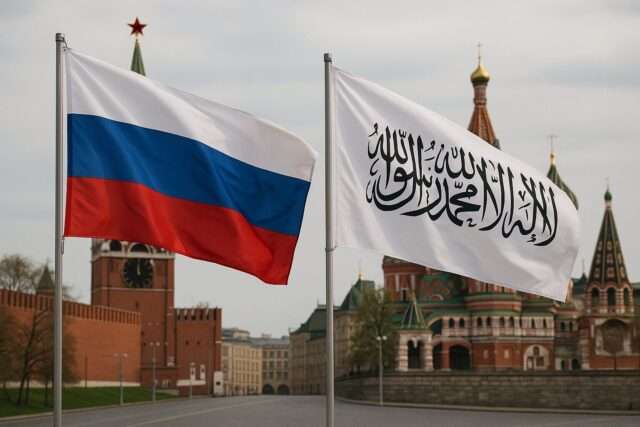
On July 3rd, Russia announced its decision to formally recognise the Afghan Taliban’s Islamic Emirate of Afghanistan (IEA) regime as the country’s legitimate government. This marks a significant event nearly four years after the Taliban returned to power, coinciding with the withdrawal of American and NATO forces from Afghanistan in August 2021. For the Taliban’s IEA government, recognition by Russia represents a greater diplomatic victory and is seen as a likely precursor to bringing the group closer to legitimacy, which has broader regional and international implications.
Even though some states had limited contact with the Taliban regime, Russia’s recognition of the IEA government represents a fundamental departure from the international consensus of withholding recognition until the Islamist group expressly committed to upholding human rights and establishing an inclusive administration. As such, this recognition raises questions such as: what does it mean for Russia to recognise the IEA government; how important was the timing; and what should the implications be for international diplomacy, regional security and the international counterterrorism efforts.
Historical Context of Russia–Afghanistan Relations
Russia’s approach towards Kabul continues to be shaped by the shadow of its predecessor Soviet Union’s invasion of Afghanistan in 1979. That resultant decade-long war, which was fiercely resisted by U.S.-backed, Gulf-sponsored and Pakistan-trained Afghan mujahideen, not only devastated Afghanistan, but it also contributed to the unravelling of the Communist Soviet Union (USSR) in 1991. Since the Cold War’s end, Russia has remained cautious in its Afghan policy.
It may be recalled that after the Soviet withdrawal from Afghanistan and subsequent civil war in the 1990s, as its successor state, Russia became one of the few states, alongside India and Iran, supporting the Ahmad Shah Masoud-led Northern Alliance against the Pakistan-supported groups, which eventually coalesced into the Taliban in 1994. Though the Islamist group emerged as the dominant force and established its rule over Afghanistan in 1996, its regime lasted only a few years until the U.S.-led invasion in 2001. After its overthrow, Moscow backed international stabilisation efforts and considered the presence of American and NATO forces as a buffer against Islamic extremism. But as NATO, a military bloc established nearly eight decades ago to contain then Communist Soviet Russia, gradually reduced the presence of its forces in the mid-2010s in Afghanistan, it led to the resurgence of the Taliban. In such a changing scenario, Russia began informal contacts with the Taliban, hosting a few Afghan dialogue conferences from 2015 onwards. As such, this recognition in 2025 thus crowns a long, carefully calibrated process of engagement with the Afghan Taliban.
Why Recognise the Taliban Now?
Russia’s decision seems motivated by several geopolitical and strategic considerations. Firstly, given its continuous conflict with the West over Ukraine, it indicates Moscow’s larger attempts to subvert Western influence and establish its own standing as a major world power. Due to Western sanctions that have isolated it politically and economically, Russia is turning more and more towards Asia and the Global South in an effort to form new coalitions and alliances.
Secondly, Afghanistan is the source of both the drug trade and terrorism, which greatly worries Russia. Moscow wants to get Kabul to make strong promises to stop cross-border terrorism, especially from the Islamic State-Khorasan Province (ISIS-K) and other extremist groups that operate close to Central Asia, so it is recognising the Taliban. Russia’s security interests in former Soviet republics like Tajikistan and Uzbekistan are meant to be strengthened by this action.
Thirdly, Russia wants to make Afghanistan a more important economic location. Afghanistan has enormous mineral deposits, including lithium and rare earth elements, despite the Taliban’s worldwide isolation. Particularly when China is growing its influence through the Belt and Road Initiative, Russia is interested in these resources for future infrastructure and extraction projects. Trade facilitation, investment safeguards, and formal agreements are made possible by recognition.
Consequences of Diplomatic Recognition
Russian recognition grants the Taliban IEA’s regime a formal status as the country’s legitimate government, reshaping its international dynamics by potentially paving the way for broader recognition from other countries. For Afghanistan and Russia, it allows the two countries to negotiate formal agreements, exchange ambassadors, and engage in state-to-state political cum economic cooperation. To start with, Moscow accepted the diplomatic credentials of Mawlawi Gul Hassan Hassan, Taliban nominee, allowing him to take over as the IEA ambassador to Russia formally.
This external recognition will further legitimise the Taliban’s government internationally, while delegitimising its opposition, the Panjshir-based National Resistance Front (NRF). While the NRF has challenged the legitimacy of the IEA by continuing a low-scale insurgency and has established its temporary government to bestow some level of legitimacy upon itself, it does not have the external support needed to present a credible challenge to the IEA.
Moreover, as a permanent member of the United Nations Security Council (UNSC) with veto power, Russian move could also embolden the few countries (including China, Iran, Pakistan, and Turkey) that have engaged diplomatically with the Taliban at varying degrees, though short of formal recognition, to follow the lead. As such, this has the prospect of leading to Afghanistan’s reintegration into multilateral forums, thereby significantly altering the Taliban’s position in international politics.
Human Rights and Ethical Dilemmas
Perhaps the most controversial aspect of Russia’s decision is its disregard for human rights concerns in Afghanistan, which have been flagged by various international organisations. It should be noted that after retaking power in 2021, the Taliban led IEA government has banned girls’ education beyond grade six, restricted women’s public participation, curtailed media freedoms and crushed any form of dissent against its governance.
Therefore, by recognising the Taliban government even as the international community preconditioned recognition to such reforms, the Russian government risks legitimising repression and weakening global human rights norms. This is something that sets a precedent of armed groups seizing power by force, violating freedoms, and still achieving international legitimacy if they serve geopolitical interests.
Security Risks and Extremist Blowback
Moscow hopes that this recognition will help contain extremism in both Afghanistan and the broader region. But the risks remain significant as questions over the ability of the Taliban government to contain groups like Islamic State-Khorasan (IS-K) persist. For instance, the Islamic State operatives from Central Asia carried out a deadly attack on the Crocus City Hall concert venue outside of Moscow in March 2024, leaving nearly 150 people dead.
In such a scenario, if the IEA government fails to contain such threats, or worse, if figures within the Taliban movement sympathise with these Islamic extremist groups, Russia may have more instability along its southern borders. Additionally, radical elements within the Caucasus and Chechnya, or anywhere within Russia, could also be emboldened, thereby creating further instability.
Regional and Global Implications
Russian recognition of the Taliban government reasserts its influence in Central Asia, where states such as Kazakhstan, Kyrgyzstan, and Turkmenistan will closely watch Moscow’s engagements with the Taliban government. It also positions Russia to shape Afghan policy on trade, infrastructure, border security, and water sharing. More broadly, Moscow’s step reflects a shifting diplomatic order where alliances are increasingly formed based on strategic necessity rather than shared ideological values. As long as they accomplish geopolitical goals, authoritarian and non-democratic governments can be accepted under this paradigm. If this trend deepens, it may have a long-term impact on the global norms of democracy and risk human rights erosion.
For India, particularly in light of the current strain in relations with the United States due to President Trump’s tariff war, this Russian move may also speed up its engagements with the IEA government. Notwithstanding India’s longstanding position against the Taliban movement due to its deep ties with Pakistan and anti-India groups with a history of violence in Kashmir, it should be noted that New Delhi has increased diplomatic engagements with the Taliban government in the last two years at varying levels. For instance, India’s External Affairs Minister S. Jaishankar spoke to Taliban Acting Foreign Minister Amir Khan Muttaqi in May 2025, making it the highest level of direct engagement between the two countries yet.
Conclusion
Russia’s recognition of the Taliban’s IEA government marks a bold and consequential shift. While the Taliban government stands to gain diplomatic legitimacy, Russia can obtain strategic advantages of securing the southern borders, access to Afghan resources, and undermining continued Western influence. Yet recognition does not guarantee stability, acceptance, or economic revival. Recognition will only be symbolic, and without implementing genuine reforms, it might even encourage hardline sections inside the Taliban, thereby threatening the very stability of the government. Ultimately, Russia’s move illustrates how foreign diplomacy is changing in a multipolar world. It establishes a precedent in which normative standards are frequently subordinated to strategic goals. It remains to be seen if this will result in a more fragmented global order or a stable Afghanistan.
Wonderful article and have displayed a new game altogether. Commendable 👏