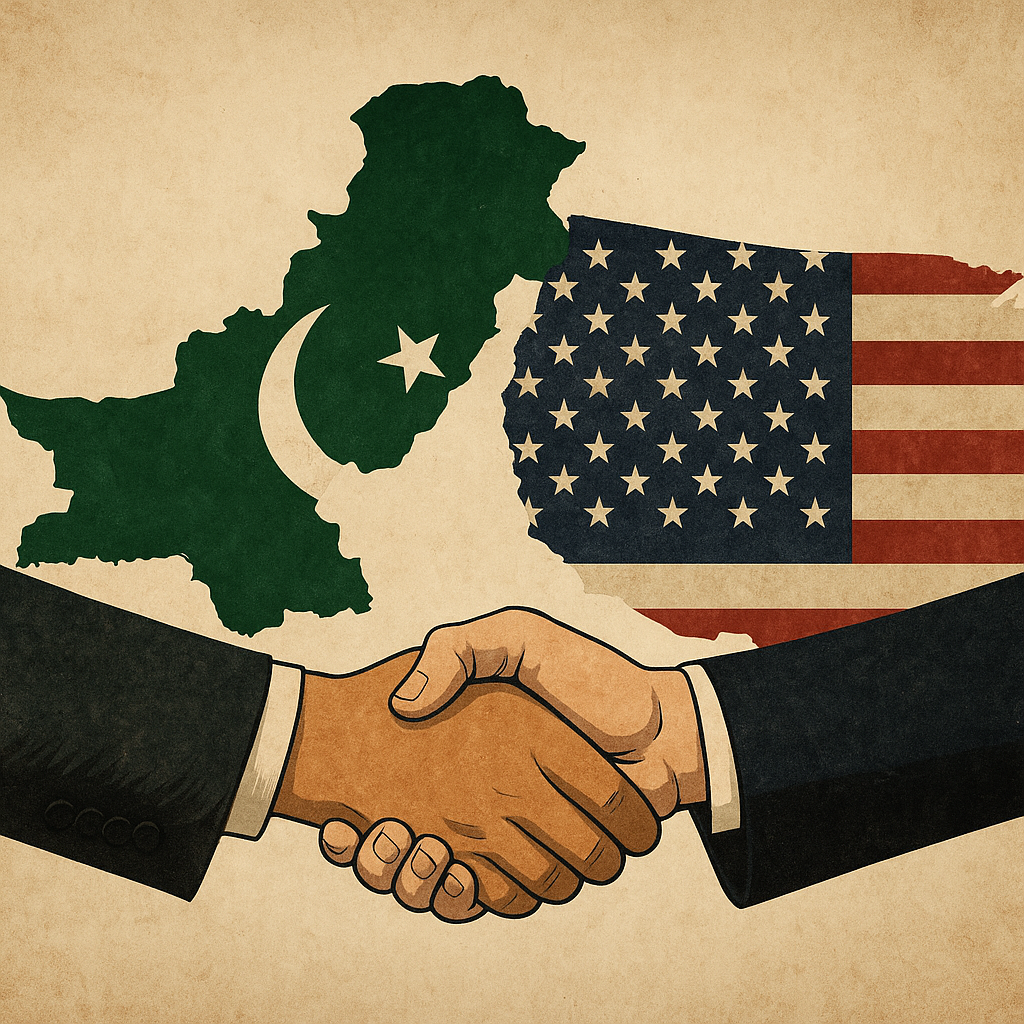
Summary: The article explores the evolving U.S.-Pakistan relationship in the wake of the May 2025 India-Pakistan military clash, marked by unconventional engagement through cryptocurrency, energy trade, and a new free trade agreement. It reveals how personal networks tied to Trump’s family and private business interests are reshaping diplomatic ties. While this realignment signals a pivot in Pakistan’s foreign policy, it risks deepening economic vulnerabilities under the guise of strategic gain. The U.S. is targeting Pakistan’s rare earth reserves through private firms, offering an alternative to Chinese mining influence while embedding strategic economic ties.
Key Highlights
The U.S. is targeting Pakistan’s rare earth reserves through private firms, offering an alternative to Chinese mining influence while embedding strategic economic ties.
Pakistan engaged with a Trump-linked crypto firm, signalling a backchannel to Washington via digital finance rather than traditional diplomacy.
A Free Trade Agreement was signed under Trump, but it imposes tariffs and offers limited benefits for Pakistan’s struggling export sector.
Pakistan began importing expensive U.S. crude, marking a symbolic shift from Gulf suppliers that reflects political alignment more than economic logic.
The new engagement is driven by private American actors and political families, not state institutions, risking long-term dependency and bypassing structural reform.
The military clash between India and Pakistan in May 2025 brought many things into sharp focus. One of them was the quiet realignment taking place between Washington and Islamabad. For years, this was a relationship weighed down by suspicion, broken promises, and aid fatigue. But in the past few months, something has shifted. And not all of it is about diplomacy.
It began with crypto.
The Crypto Backchannel
The first signs came in April. Just days after a terror attack in Pahalgam, Pakistan signed a deal with a little-known American firm, World Liberty Financial. The company had direct links to Donald Trump’s family. His sons, along with Jared Kushner, held 60% of the firm. A high-level delegation flew to Islamabad. Within days, Pakistan’s newly formed Crypto Council became a full-fledged regulatory body – the Pakistan Digital Asset Authority.
What has to be noted about this is that Pakistan’s financial system was opening its doors to a Trump-linked crypto business at a time when the US president was calling for calm in South Asia.
Many read it as a transaction. In the middle of its military operation (Operation Sindoor), India found Washington unusually quiet. Trump later said he had forced India to stand down by threatening economic sanctions. That was a bold claim. But it echoed something deeper. Pakistan had found a new way to talk to the US, not through old strategic narratives, but through digital finance and personal access. General Asim Munir was made a Field Marshal to have lunch with President Trump at the White House.
Minerals, Debt, and Strategic Risk
A quiet but growing part of this story is also minerals. Pakistan’s trade ministry has already listed mining as one of the key areas for collaboration under the new economic framework. Lithium, copper, rare earths — resources essential for green energy and electronics — are scattered across Pakistan’s northwest. China already has a head start in this region. But the US is trying to get in through private firms and strategic funding.
The inclusion of mining and digital finance in the broader trade and energy narrative is not accidental. It’s part of a reshaped relationship where Washington doesn’t want to prop up Pakistan with aid. Instead, it wants to tie Pakistan’s economy to sectors that serve American commercial and strategic interests.
Pakistan’s leadership sees this as an opportunity to break from IMF cycles. But the risk is that this realignment could lead to greater dependency of a different kind — one driven not by multilateral lenders, but by private actors linked to American political families.
A Trade Deal Wrapped in Debt
The US and Pakistan announced a Free Trade Agreement, imposing 19% tariffs on Pakistani goods, just five days before President Trump announced the 25% tariffs on India. The background to this is that a bilateral investment treaty had been in the works since 2004. For years, Pakistan’s business elite wanted access to the American market, especially its textiles. The US was hesitant. However, with Trump in office, the FTA was signed.
And this is where things get complicated.
The Pakistan Business Council (PBC), a powerful voice of the country’s corporate sector, had long warned against a full trade deal with the US. Their 2019 report was cautious. It pointed out that Pakistan lacked the capacity to compete in high-value sectors. Its textile exports to the US were already facing tough competition from Bangladesh and Central America. And the US didn’t offer duty-free access to many of the goods that Pakistan wanted to export. Without deep structural reform, the council feared that an FTA would leave Pakistan more dependent on imported goods.
Those warnings have not gone away.
Even now, Pakistan’s exports remain flat, hovering around $30 billion, while imports have crossed $65 billion this year. The country is struggling with an external debt of nearly $130 billion. The FTA may boost specific sectors like rice, home textiles, and surgical instruments. However, the broader economy still lacks the scale, productivity, and technological depth needed to benefit from such a deal fully.
For the US, the FTA gives its firms legal protection and arbitration rights under international law. That’s good for American investors. But for Pakistan, it may open up vulnerable sectors to US imports without offering enough support to domestic producers.
Oil Fuelling a New Bonhomie
The surprising and unbelievable part of the story is when Trump announced a joint project with Pakistan to develop its oil reserves. The choice of words was vague – “massive reserves.” What makes this deal so surprising is that Pakistan doesn’t actually have any large oil reserves to speak of. Over the past two decades, several international oil companies have explored potential fields in Pakistan. But none of them made any major discoveries.
So when Trump called it a partnership to develop Pakistan’s “massive oil reserves,” it raised eyebrows. There is no evidence of such reserves. What it really means is that Pakistan is now buying oil from the US, not producing it at home. This is a shift. For decades, Pakistan sourced its oil from Gulf countries like Saudi Arabia, the UAE and Kuwait. These were not only geographically closer but also offered better terms, often with deferred payment options or concessional prices. So why shift to US crude, which is costlier and comes with higher transport costs?
The answer lies in politics. The deal was signed soon after Trump imposed tariffs on India. It was meant to show which country was being welcomed, and which one was being punished. The first shipment – one million barrels of West Texas Intermediate crude – will come through Vitol, a global commodities trader, and will be processed by Cnergyico, Pakistan’s largest private refiner. The symbolism is hard to miss. This is the first time Pakistan is importing crude directly from the United States.
For Pakistan, the deal may give it a short-term diplomatic win. It signals closeness to Washington. But in economic terms, it raises hard questions. The country is already struggling with a trade deficit and a weak currency. Its energy bill was $11.3 billion in the last financial year, which was nearly one-sixth of its total imports. Buying more expensive American crude will only add to the burden.
In simple terms, this is not about tapping hidden resources underground. It is about showing political alignment above ground. The oil is real. The reserves, not so much. What Pakistan gets is access to American energy. What the US gets is a loyal follower at a time when global alliances are being reshuffled.
New Direction in the Relations
Since May, US-Pakistan relations have moved in directions few expected. Crypto, oil, and free trade are now the bridges being built between two deeply mismatched economies. For Pakistan, it’s a desperate pivot towards growth and global relevance. For Trump’s America, it’s a mix of business, family interest, and geopolitical calculation.
This isn’t the old Cold War alliance. It’s something newer, more opaque, and shaped by business interests and possibly geopolitical needs. India will take time to figure it out. And if Pakistan fails to strengthen its own domestic capacity, this new chapter might end like many old ones with promises made, deals signed, and very little left for ordinary Pakistanis.
The views expressed are the author’s own.
Scholarly analysis by the learned Professor. What is remarkable is that Professor has limited himself to proper analysis and avoided India’s political divided.
Nice one.