Dr Syed Mohammad Raghib
Since Israel’s war on Gaza following the October 7, 2023, cross-border attack by Palestinian Hamas Movement, Egypt-Israel fragile status quo, established by the 1979 Camp David Peace Accords, has been recurrently tested by Israeli actions, including its May 2024 takeover of the Philadelphi Corridor, which is a narrow buffer zone along the Gaza-Egypt border. For a moment, it sparked fears of a wider regional confrontation, particularly as Israel expanded its war from Gaza to Lebanon and Syria. Egypt responded with a multipronged approach, including diplomatic denunciations, heightened military posture in Sinai, and warnings that the foundations of peace are under threat. Beyond straining bilateral ties, Israeli occupation of the corridor impeded humanitarian aid to Gaza. This article makes an attempt to detail the significance of this event in historical context and highlights what drives Israeli actions, its ramifications for the Egypt-Israeli relations.
Background: The Strategic Significance of the Philadelphia Corridor
The Philadelphi Corridor is a 14-kilometre-long, 100-meter-wide strip of land separating Egypt and Gaza, Palestine. Under the 1979 peace treaty and subsequent agreements in 2005 and 2014, Israel withdrew from Gaza, leaving the corridor demilitarised under Egyptian sovereignty with shared security responsibilities.
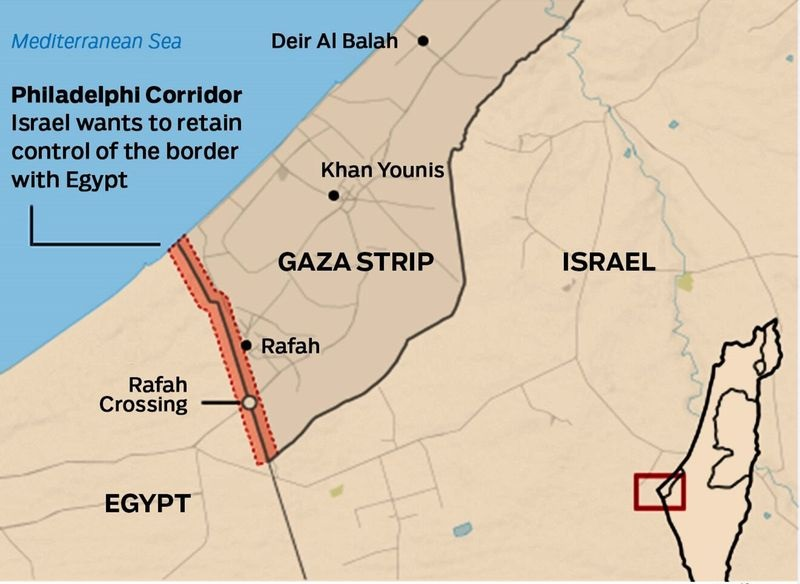
Historically, it has been a flashpoint due to its strategic value. Despite Egypt’s recent efforts to destroy tunnels beneath the corridor, Israel maintains that Hamas has used them to smuggle weapons and fighters into Gaza. After launching its ground campaign in Rafah in May 2024, Israel claimed it needed full control of the corridor to prevent Hamas from rearming. By June, Israeli forces had seized the entire corridor, including the critical Rafah border crossing.
Egypt’s Response: From Diplomatic Silence to Public Indignation
The Egyptian government, which has historically been discreet in its dealings with Israel, responded with rare public outrage. President Abdel Fattah el-Sisi’s administration filed official objections, declaring that the Israeli move was a danger to Egyptian sovereignty and a blatant breach of the Camp David Accords. In early June, Sameh Shoukry, the Egyptian foreign minister, warned that “any continued presence of Israeli forces on the Egyptian border will be considered a hostile act and a breach of established international agreements”. Egypt essentially stopped the humanitarian supply convoy entering Gaza by suspending cooperation at the Rafah border crossing. Furthermore, hundreds of international charity workers who were trying to plan a symbolic march in support of Palestinians were denied entry into Gaza by Egypt. Concern was raised in the regional capitals when the Egyptian military was observed bolstering its positions in North Sinai by stationing more troops, armoured units, and air defence systems close to the corridor.
Egypt’s most grave charge was that Israeli actions violated the Camp David Accords. While Article II of the accord Article II of the treaty guarantees mutual respect for sovereignty and territorial integrity, security annexes restrict military deployments in specified zones of Sinai and surrounding territories. By unilaterally invading and controlling the corridor, Israel undermined a bilateral framework that has ensured peace for over four decades. Egyptian analysts contended that even if Israel’s rationale were grounded in counterterrorism, its lack of coordination demonstrated a dangerous disregard for Cairo’s strategic concerns.
Egypt’s firm stance found support among Arab nations, including Jordan, Saudi Arabia, the UAE, and Qatar. During an emergency Arab League session in Cairo, member states issued a unified statement condemning Israel’s “illegal occupation of Egyptian border zones” and demanding a return to peace treaty conditions. The Organisation of Islamic Cooperation (OIC) also discussed Egypt potentially joining South Africa’s case against Israel at the International Court of Justice, accusing it of genocide and violations of humanitarian law.
Calculus of Security: Israel’s Perspective
Israel has construed the control over the corridor as more than mere preventing smuggling through underground tunnels, portraying it as a security risk, particularly after the October 7 attacks. Defence Minister Yoav Gallant described the takeover as a “strategic necessity to cut off Hamas’s lifeline to the outside world.” Israeli intelligence assessments claimed that despite Egypt’s tunnel destruction efforts since 2014, new tunnels, some allegedly aided by Iranian networks, continued to emerge. Despite such posturing from Benjamin Netanyahu’s government, some Israeli security analysts also cautioned against alienating Egypt, which has acted as a vital mediator and peace partner. Some reports suggested that the Israeli actions strained military coordination and intelligence sharing between the two states.
Humanitarian Fallout: Rafah Border and Gaza Crisis
The obstruction of humanitarian aid to Gaza was arguably the most direct effect of the Israeli invasion. With other crossings such as Kerem, Shalom, and Erez either damaged or limited during the war, Rafah was the main entry for food, fuel, and medical supplies to Gaza. Following Egypt’s suspension of cooperation, aid convoys were stalled at the border, worsening Gaza’s dire humanitarian crisis. In late June, the UN warned that 20,000 Gazans faced starvation within weeks, with over 500,000 experiencing acute food insecurity. Egypt insisted it could not coordinate aid while Israeli forces occupied the crossing and called for Israel’s full withdrawal and reinstatement of prior arrangements, including the European Union Border Assistance Mission (EUBAM), which oversaw the crossing until 2007.
The Broader Picture: Egypt’s Domestic and Geopolitical Calculus
Egypt’s quick response stems from local and geopolitical considerations and legal arguments. With massive demonstrations in support of Palestinians breaking out in Cairo, Alexandria, and other cities and towns, President el-Sisi faced mounting public outrage over the deteriorating humanitarian situation in Gaza. Additionally, a perception took hold in the Egyptian power corridors that the country’s long-standing position as the gatekeeper of Gaza and a regional mediator was in jeopardy. By seizing Rafah and the tunnels on its own, Israel weakened Cairo’s position, particularly when Iran and Turkey sought a greater role in the region with a more rhetorical solidarity with Palestinians in Gaza.
What’s Next? Situations and Strategic Alternatives
A few significant events will determine the course of Egypt-Israel ties in the future:
- Withdrawal or Monitoring Mechanism: Egypt may restart cooperation without needing a complete IDF pullout if Israel consents to a third-party mechanism along the corridor, such as UN or EU monitors.
- Diplomatic Guarantees: Egypt may want formal assurances from the US or the UN that the terms of the peace deal will be respected and that Israeli forces won’t be stationed on its territory indefinitely.
- Humanitarian Truce: A ceasefire agreement between Israel, Egypt, and Hamas—perhaps mediated by the United States or Qatar—could defuse tensions and resume humanitarian supplies.
- Breakdown Scenario: Long-term deterioration could result from Egypt downgrading diplomatic ties, suspending certain treaty duties, or appealing to international courts if the problem is unresolved.
Conclusion
Israel’s takeover of the Philadelphi Corridor brought Egypt-Israel relations to their lowest point in more than four decades. While both nations have reasons to avoid open conflict, decades of stability risk unravelling amid eroding coordination and trust. For Israel, the issue is security and strategy; for Egypt, it is sovereignty and dignity. The international community, especially the U.S. and EU, must act swiftly to mediate a diplomatic resolution. Regional stability, humanitarian relief, and the sanctity of international agreements hang in the balance. In this volatile region, a narrow strip of land has become the epicentre of a far wider struggle for power, influence, and peace.
Dr Syed Mohammad Raghib works as a Research Officer at IIPA, New Delhi. He holds a doctorate in International Studies from Jawaharlal Nehru University, New Delhi. The views expressed in this article are the author’s own and do not reflect the editorial views of the Middle East Outlook.